
The Day Everything Clicked
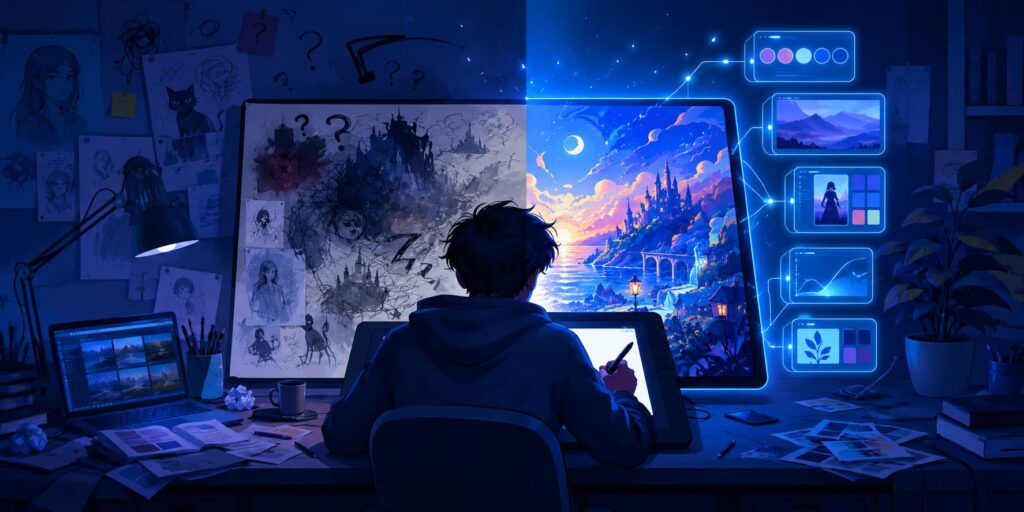
I remember sitting in front of my computer at 11 PM, frustrated beyond belief. I’d been working on the same digital painting for four hours, and it still didn’t feel right. The colors were off. The style was confused. I kept switching between trying to make it look photorealistic and pushing it toward abstract and it ended up looking like neither.
That’s when my designer friend Sarah texted: “Have you tried StarryAI yet?”
Honestly, I was skeptical. I’d heard the “AI will replace artists” warnings just like everyone else. But that night, desperate and tired, I decided to give it a shot. What happened next surprised me.
What Exactly Is StarryAI?
Think of StarryAI like having a knowledgeable artist friend sitting next to you, offering suggestions in real-time. It’s not here to create art for you. Instead, it helps you create art better.
StarryAI is an AI-powered digital art tool that helps artists in three main ways:
- Suggests style combinations you might never think of on your own
- Recommends colors and textures that match the mood you’re going for
- Works inside tools you already use (like Photoshop and Procreate)
The key thing to understand: this tool amplifies what you can already do. It doesn’t replace your creativity it unlocks parts of it you didn’t know existed.
The Numbers Don’t Lie: Why Artists Are Jumping In
Before I go further, let me show you something. According to a 2023 survey, more than 6 out of every 10 digital artists now use AI tools to experiment with new styles and techniques.
That’s a massive shift in just a few years.
Why? Because the results speak for themselves. Artists who use these tools report they can:
- Finish projects 30-40% faster
- Explore new artistic directions without months of trial and error
- Combine different art styles in ways that feel natural and intentional
I’m not just making this up. I’ve watched it happen in my own work and in the work of other artists in my network.
The Game-Changing Features (And How They Actually Work)
Let me break down the features that actually matter, not just the buzzwords.
Feature 1: The Style Blender
Remember how I was struggling to pick between photorealistic and abstract? Here’s what StarryAI’s style blender does:
You feed it two different art styles. Say, Impressionism (soft, dreamy, loose brushstrokes) and Surrealism (strange, dreamlike, unexpected imagery). StarryAI analyzes thousands of artworks in both styles and shows you what happens when you blend them.
It’s like having access to a creative laboratory where you can safely experiment before you invest hours in a direction that won’t work.
Real example: Emma Lopez, a digital artist from New York, used this feature to combine Impressionism with surrealism. Instead of spending weeks trying different approaches, she had a solid direction in two hours. Her resulting series was featured in three major digital art exhibitions. The tool didn’t make the art for her it just cleared the fog so she could see the path forward.
Feature 2: Mood-Based Color Suggestions
This one genuinely changed how I work.
You know that feeling where you know something isn’t right, but you can’t figure out what? Usually, it’s the colors. Maybe your piece is supposed to feel anxious and unsettled, but it looks calm. Maybe you want it to feel hopeful, but it looks sad.
StarryAI’s contextual suggestion feature works like this:
You tell it what emotion or theme you’re going for. Anxious? Peaceful? Energetic? Melancholic? The tool then recommends adjustments to:
- Color saturation and tone
- Texture density
- Form and shape emphasis
Instead of randomly trying 50 different color palettes, you get suggestions that actually serve your vision. I’ve saved literally hours using this feature alone.
Feature 3: It Plays Nice With Your Favorite Tools
Here’s the thing that sold me: you don’t have to abandon Photoshop or Procreate.
StarryAI integrates directly into these programs. You’re not learning a new software. You’re not switching windows constantly. You’re just adding a new panel of suggestions to your existing workflow. It’s seamless, and frankly, that’s what makes the difference between a tool people actually use and one that sits collecting digital dust.
How I Actually Use It (Step by Step)
Let me give you a practical example of how this looks in real work.
Step 1: Start with your concept I’m creating a piece about the feeling of nostalgia. It needs to be warm, slightly faded, and a little bit dreamy.
Step 2: Get suggestions I describe the mood to StarryAI. It recommends a blend of soft Impressionist techniques with touches of vintage photography color grading.
Step 3: Experiment safely I test these suggestions on a small section first. No commitment. No wasted hours. Takes maybe 10 minutes.
Step 4: Apply what works If it feels right, I apply it to the full piece. If it doesn’t, I try something else.
The whole process that used to take me 4 hours now takes about 90 minutes. And the final result is stronger because I’m working with intention, not just hoping something clicks.
The Real Question: Will This Replace Artists?
I asked myself this question a lot when I started using StarryAI. Here’s my honest answer: No. Not even close.
Let me explain why.
Art requires:
- A vision of what you want to say
- The technical skill to execute
- The judgment to know what works and what doesn’t
- The courage to take risks
StarryAI handles none of those things. It’s a suggestion engine. A really good one, but still just a suggestion.
You still need to know your subject. You still need to make thousands of tiny decisions. You still need to know when to accept a suggestion and when to ignore it.
What StarryAI does eliminate is the wasted time. The spinning your wheels. The false starts. It’s like having a GPS it doesn’t replace the journey, it just makes the journey clearer.
Getting Started (Without Feeling Overwhelmed)
When I first logged into StarryAI, I wasn’t going to lie it felt like a lot. There are tutorials, templates, features, community forums. It can be intimidating.
Here’s how to not get overwhelmed:
Step 1: Start with one feature Don’t try to use everything at once. Pick the style blender or the color suggestion tool. Master that one thing first.
Step 2: Use the built-in templates StarryAI has templates for different art styles. Use them. They’re not meant to constrain you meant to show you what’s possible.
Step 3: Join the community Honestly, the StarryAI community has been incredibly helpful. Other artists are sharing their experiments, answering questions, and pushing each other to try new things. Don’t be shy ask questions.
Step 4: Give yourself permission to fail The whole point is to experiment. Not every combination will work. That’s fine. That’s how you learn.
The Bigger Picture: Where Digital Art Is Headed
Here’s what I think is really happening. We’re not at the end of an era for human artists. We’re at the beginning of a new one.
The tools are becoming better. The possibilities are expanding. And the artists who figure out how to use these tools not as replacements for their skills, but as extensions of them are going to create work that would have been impossible five years ago.
StarryAI is just one tool. But it’s a signal of what’s coming. In five years, digital artists who aren’t using some form of AI assistance will be at a disadvantage. Not because AI is replacing them, but because these tools genuinely make you better.
My Honest Take
I went from skeptical to convinced pretty quickly. But here’s what matters: my experience is backed up by what I see in the broader creator community.
Digital artists are adopting these tools not because they’re trendy, but because they work. They save time. They inspire new directions. They make the creative process less frustrating and more joyful.
Is StarryAI right for every artist? Probably not. Some artists will prefer traditional methods, and that’s valid.
But if you’re someone who:
- Spends too much time on dead ends
- Wants to experiment with new styles faster
- Gets stuck deciding between artistic directions
- Works in Adobe or Procreate
…then honestly? Try it. The worst that happens is you learn something about your own process.
The Bottom Line
That night when I first used StarryAI, I finished my painting by 1 AM. Was it a masterpiece? No. But it was done. More importantly, it was intentional. Every choice served the piece.
That’s the real value. Not magic. Not replacing artists.
Just better tools. Better choices. Less frustration. More creativity.
And if that’s not worth exploring, I don’t know what is.
Ready to try StarryAI?
Start with the free templates and see if it fits your workflow. You might be surprised at what becomes possible.