Writing lesson plans every week can drain hours you’d rather spend teaching. I tested dozens of ChatGPT prompts for CBSE lesson plans to see which ones actually work in a real classroom. Below, I’m sharing the 20 best ones, plus simple tips to customize them for any class or subject.
What Are ChatGPT Prompts for CBSE Lesson Plans?
Before we jump into the list, let’s clear up two simple terms. Once you get these, the rest of the article will feel easy.
What Is a “Prompt” (In Very Simple Words)?
A prompt is the instruction you type into ChatGPT. Think of it like placing an order at a restaurant. If you say “get me food,” you’ll get something random. If you say “one masala dosa, less spicy, with extra chutney,” you get exactly what you want.
What Are “ChatGPT Prompts for CBSE Lesson Plans”?
These are ready-made instructions that ask ChatGPT to build lesson plans based on the CBSE curriculum. They mention the class, subject, chapter, time, and learning goals. The better the prompt, the more classroom-ready the lesson plan you get back.
Why Use ChatGPT for CBSE Lesson Planning?
I was skeptical at first. But after a few weeks of using ChatGPT for lesson planning, I noticed real gains. Here’s where it helps most.
Saves You Time
A lesson plan that took me 45 minutes now takes about 10. ChatGPT handles the first draft, and I spend my energy polishing it. That’s time back for checking notebooks or simply resting.
Matches CBSE/Class Needs
When you mention the class, chapter, and NCERT textbook, ChatGPT shapes the plan around them. It understands terms like competency-based learning, learning outcomes, and CBSE-style questions.
Makes Differentiation Easy
Every class has fast learners and students who need more time. ChatGPT can create two or three versions of the same activity in seconds.
Gives Fresh Ideas & Activities
We all run out of ideas sometimes. ChatGPT suggests games, role plays, and hands-on tasks that keep lessons lively.
Improves Assessment & Feedback
It can draft exit tickets, quizzes, and rubrics that match your lesson goals.
Supports Communication & Admin
Parent notes, homework reminders, and lesson summaries become quick tasks. If you want to go beyond ChatGPT, I’ve compared other AI tools that help teachers too. You can also read how AI assistants can take on routine classroom work.
Takeaway: ChatGPT works best as a fast first-draft partner, not a replacement for your planning.
How to Write Effective ChatGPT Prompts for CBSE Lessons
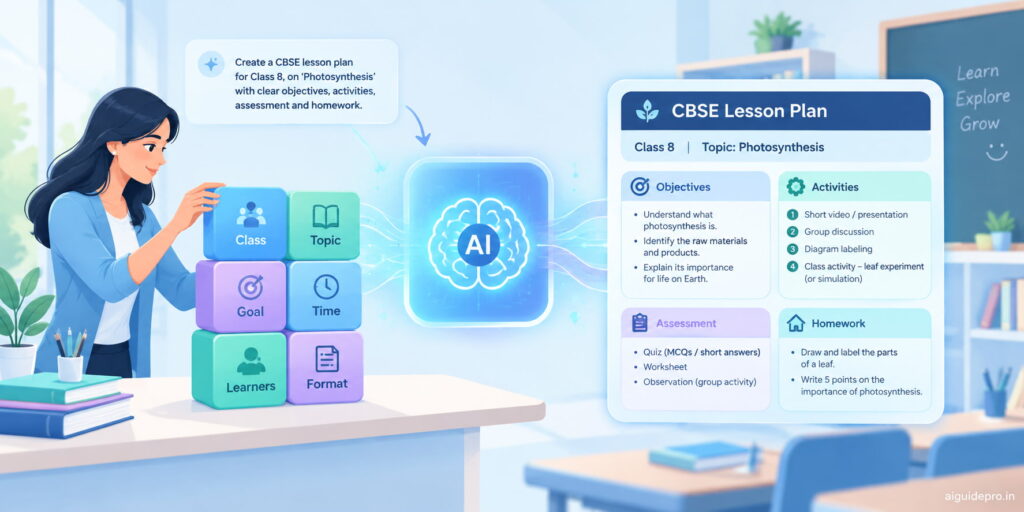
A good prompt is like a good recipe. Leave out one ingredient and the dish tastes off. I follow these six steps every time I write ChatGPT lesson plan prompts.
- Define the class and subject. Start with something like “Class 7, Science.” This sets the language level and depth right away.
- Mention the CBSE topic or chapter. Name the exact NCERT chapter, such as “Chapter 4: Heat.” Without it, ChatGPT may pick a broad or off-syllabus topic.
- Specify learning objectives. Tell it what students should know or do by the end. For example, “Students should explain conduction, convection, and radiation with examples.”
- Choose the lesson format. Do you want a 5E model, a 40-minute period plan, or a multi-day plan? Say so clearly.
- Add student level and learning needs. Mention mixed abilities, slow learners, or English language learners. Knowing your learners shapes everything, and this guide on student needs explains why that context matters.
- Request a clear and practical output. Ask for a table, bullet points, or step-by-step timing. Clear formats are easier to use in class.
Here’s how a weak prompt compares with a strong one:
| Weak Prompt | Strong Prompt |
|---|---|
| “Make a lesson plan on heat.” | “Act as a CBSE Class 7 Science teacher. Create a 40-minute lesson plan on NCERT Chapter 4: Heat for a mixed-ability class. Include objectives, a warm-up, one activity, and an exit ticket in a table.” |
Takeaway: Class + chapter + goal + format + learners + output = a lesson plan you can actually use.
20 ChatGPT Prompts for CBSE Lesson Plans
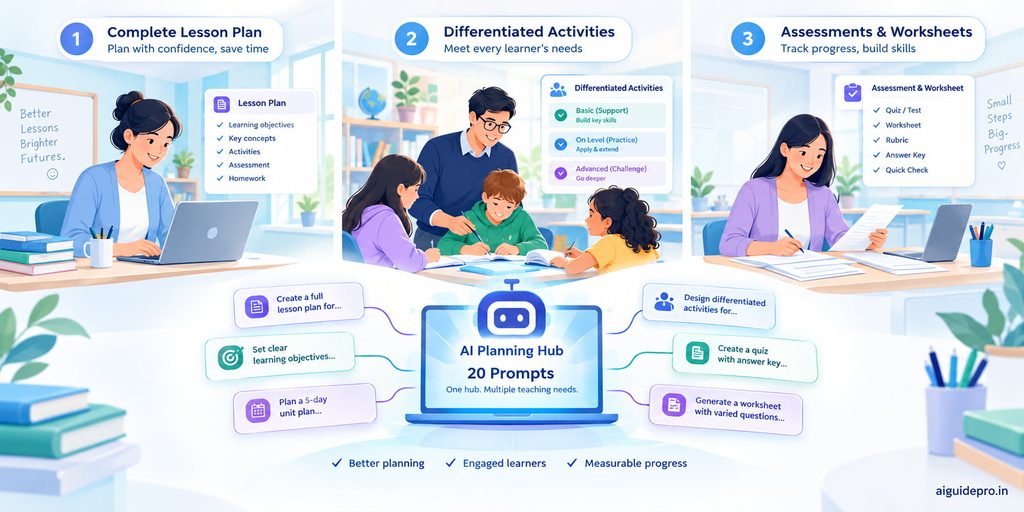
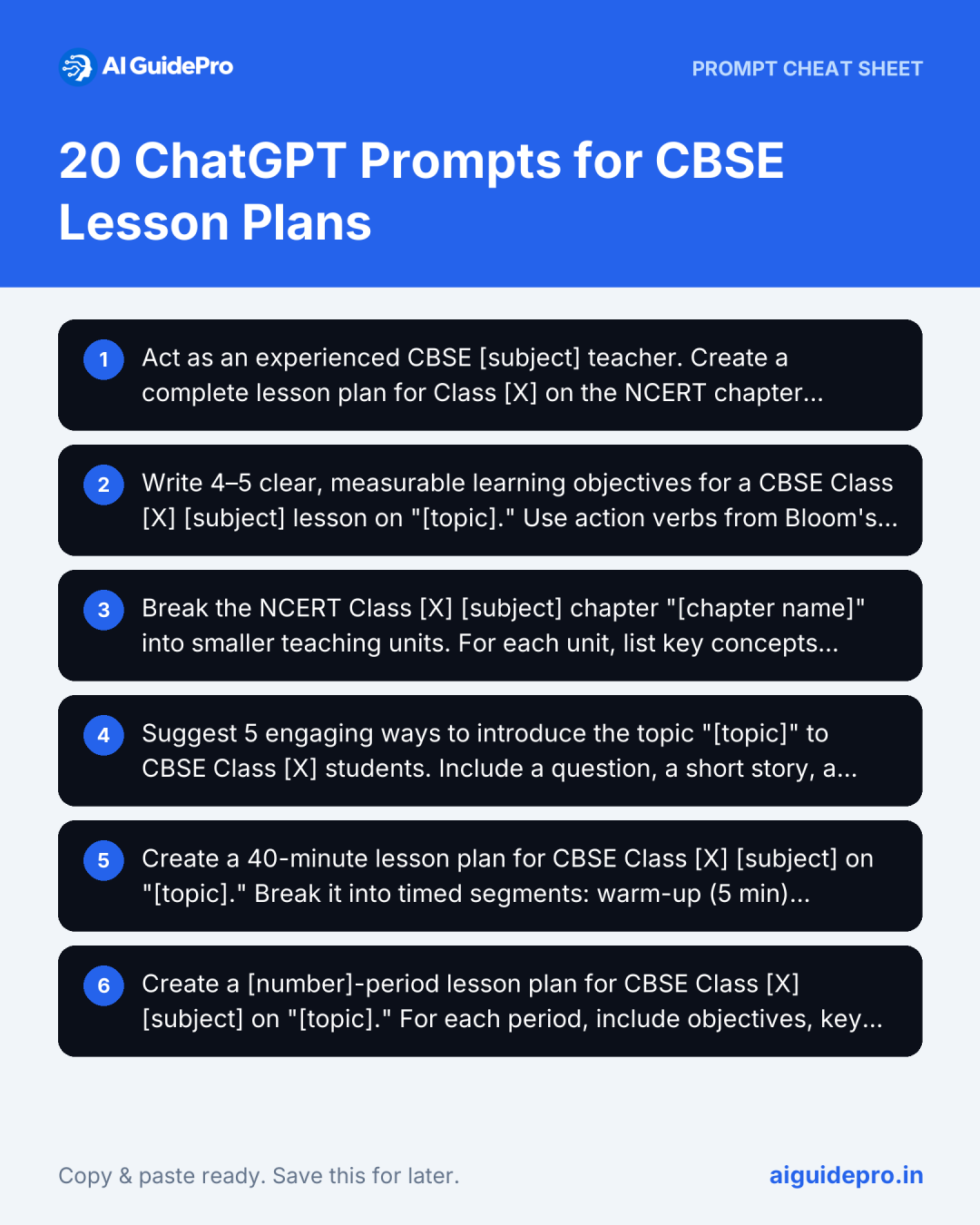
Here’s the heart of this guide. These are the ChatGPT prompts for teachers that gave me the most useful results. Replace the words in [brackets] with your own details, and you’re good to go.
1. Prompt for a Complete CBSE Lesson Plan
This is my go-to when I need a full plan from scratch. It covers everything from objectives to homework.
Act as an experienced CBSE [subject] teacher. Create a complete lesson plan for Class [X] on the NCERT chapter "[chapter name]." Include learning objectives, materials needed, a warm-up, teaching steps, one activity, assessment, and homework. Keep it practical for a class of [number] students.Best for: Starting a new chapter with no prior notes.
2. Prompt for Lesson Learning Objectives
Clear objectives guide the whole lesson. This prompt writes them in measurable language that matches CBSE learning outcomes.
Write 4–5 clear, measurable learning objectives for a CBSE Class [X] [subject] lesson on "[topic]." Use action verbs from Bloom's Taxonomy and align them with CBSE learning outcomes. Mark each objective as remembering, understanding, applying, or analysing.Best for: Filling in the objectives column of your school’s lesson plan format.
3. Prompt for a Chapter-Based Lesson Plan
Some chapters need a bird’s-eye view first. This prompt breaks a full chapter into teachable chunks.
Break the NCERT Class [X] [subject] chapter "[chapter name]" into smaller teaching units. For each unit, list key concepts, suggested number of periods, one activity, and one check-for-understanding question. Present it as a table.Best for: Planning a long chapter across a month.
4. Prompt for an Engaging Lesson Introduction
The first five minutes decide whether students tune in or zone out. This prompt gives you hooks that grab attention.
Suggest 5 engaging ways to introduce the topic "[topic]" to CBSE Class [X] students. Include a question, a short story, a real-life situation, a quick demo, and a surprising fact. Each hook should take under 5 minutes.Best for: Topics students find boring or abstract.
5. Prompt for a 40-Minute Lesson Plan
Most CBSE periods run 35–45 minutes. This prompt builds a plan that actually fits the clock.
Create a 40-minute lesson plan for CBSE Class [X] [subject] on "[topic]." Break it into timed segments: warm-up (5 min), teaching (15 min), activity (12 min), assessment (5 min), and wrap-up (3 min). Show it in a table with teacher and student actions.Best for: Daily period planning.
6. Prompt for a Multi-Period Lesson Plan
Big topics rarely fit in one period. This prompt spreads the lesson across several days with smooth links between them.
Create a [number]-period lesson plan for CBSE Class [X] [subject] on "[topic]." For each period, include objectives, key content, one activity, and a short recap question that links to the next period. Each period is [duration] minutes.Best for: Weekly planning and long units.
7. Prompt for Interactive Classroom Activities
Activities turn listening into doing. This prompt gives you options that need little or no special material.
Suggest 5 interactive classroom activities to teach "[topic]" to CBSE Class [X] students. Use low-cost materials available in a typical Indian classroom. For each activity, give the steps, time needed, and the concept it reinforces.Best for: Making activity-based learning simple and affordable.
8. Prompt for Group Learning Activities
Group work builds teamwork and communication, both key 21st-century skills. This prompt keeps every member busy.
Design a group activity for CBSE Class [X] [subject] on "[topic]" for [number] groups of [size] students. Assign clear roles (leader, recorder, presenter, timekeeper). Include instructions, expected output, time limit, and a simple peer-evaluation checklist.Best for: Collaborative learning and project days.
9. Prompt for Differentiated Learning
One lesson rarely fits every learner. This prompt creates three levels of the same task.
Create a differentiated lesson for CBSE Class [X] on "[topic]." Give three versions of the main activity: one for students who need support, one for on-level students, and one for advanced learners. Keep the same learning goal for all three.Best for: Mixed-ability classrooms.
10. Prompt for Students Who Need Extra Support
Some students need concepts broken down further. This prompt keeps the language simple and the steps small.
Explain "[topic]" for CBSE Class [X] students who are struggling with it. Use simple words, everyday examples from Indian life, and step-by-step explanations. Add 3 easy practice questions with hints and a short visual or drawing idea.Best for: Remedial classes and slow learners.
11. Prompt for Advanced Students
Fast learners get bored quickly. This prompt stretches their thinking without adding busywork.
Create enrichment tasks on "[topic]" for advanced CBSE Class [X] students. Include 2 higher-order thinking questions, 1 mini research task, and 1 creative challenge. The tasks should deepen understanding, not just add more work.Best for: Gifted learners and Olympiad-minded students.
12. Prompt for Real-World Examples
Students remember what they can connect to their lives. This prompt links concepts to things they see every day.
Give 8 real-world examples that explain "[topic]" to CBSE Class [X] students. Use situations familiar to Indian students, such as markets, kitchens, festivals, sports, or travel. Explain each example in 2 simple sentences.Best for: Making abstract topics feel real.
13. Prompt for Discussion Questions
Good questions spark good conversations. This prompt mixes easy recall with deeper thinking.
Write 10 discussion questions on "[topic]" for a CBSE Class [X] class. Start with 3 easy recall questions, then 4 understanding questions, then 3 open-ended critical-thinking questions. Add a follow-up prompt for each open-ended question.Best for: Class discussions and Socratic sessions.
14. Prompt for Worksheets and Practice
Worksheets help students practise right after a lesson. This prompt gives you a ready, printable sheet.
Create a printable worksheet for CBSE Class [X] [subject] on "[topic]." Include 5 MCQs, 5 fill-in-the-blanks, 3 short-answer questions, and 1 diagram or application question. Add an answer key at the end.Best for: Classwork, practice, and quick tests.
15. Prompt for CBSE-Style Assessment Questions
CBSE now leans toward competency-based questions. This prompt follows that pattern closely.
Create CBSE-style assessment questions for Class [X] [subject] on "[chapter]." Include MCQs, assertion-reason questions, case-based questions, and short and long answer questions. Mark each with its marks and add a marking scheme.Best for: Unit tests and board exam practice.
16. Prompt for Formative Assessment
Formative checks show who understood the lesson before you move on. This prompt keeps them quick and low-stress.
Suggest 6 quick formative assessment ideas for CBSE Class [X] on "[topic]." Include an exit ticket, a thumbs-up check, a one-minute paper, a quick quiz, a peer explanation task, and a concept map. Each should take under 7 minutes.Best for: Checking understanding during or after class.
17. Prompt for Homework and Follow-Up Activities
Homework should reinforce learning, not overload students. This prompt keeps tasks short and meaningful.
Suggest homework for CBSE Class [X] students after a lesson on "[topic]." Include one practice task, one real-life observation task, and one creative task. Each should take no more than 20 minutes and need no costly materials.Best for: Meaningful home practice.
18. Prompt for Revision Lessons
Revision works best when it’s active, not just rereading. This prompt builds a quick recap lesson before tests.
Create a 40-minute revision lesson for CBSE Class [X] [subject] on "[chapter]." Include a quick recap of key points, a mind-map activity, a 10-question rapid quiz, and a list of common mistakes students make in this chapter.Best for: Pre-exam revision periods.
19. Prompt for Cross-Curricular Lessons
The NEP 2020 encourages linking subjects. This prompt shows how one topic connects to others.
Design a cross-curricular lesson for CBSE Class [X] that connects "[topic]" in [subject 1] with [subject 2] and [subject 3]. Include a shared objective, one integrated activity, and how each subject contributes to the learning.Best for: Art-integrated and experiential learning projects.
20. Prompt for a Complete Lesson Plan With Teacher Notes
This is the most detailed prompt in the list. It adds notes that help you teach smoothly, especially for a topic you’re new to.
Act as a senior CBSE mentor teacher. Create a complete lesson plan for Class [X] [subject] on "[topic]" with teacher notes. Include objectives, timing, teaching steps, likely student misconceptions, sample answers, board work plan, and tips for managing the class.Best for: New teachers or teaching an unfamiliar topic.
Takeaway: You don’t need all 20 every day. Pick three or four that match your weekly routine and save them as templates.
How to Customize These Prompts for Different CBSE Classes
The same prompt won’t work equally well for a Class 2 student and a Class 12 student. Think of it like adjusting a shirt size. The design stays the same, but the fit must change. Here’s how I tweak each prompt by stage.
Primary Classes (Classes 1–5)
Young learners need play, stories, and short bursts of attention. Add lines like “use simple words,” “include a rhyme or story,” and “keep activities under 10 minutes.” Ask for toy-based, drawing, or movement activities.
Example add-on: “Make it playful and story-based for 7-year-olds.”
Middle School Classes (Classes 6–8)
Students here start to think more independently. Ask for experiments, simple projects, and real-life links. Mention NCERT activities and ask for art-integrated or experiential learning ideas.
Example add-on: “Include one hands-on experiment and one art-integrated task.”
Secondary Classes (Classes 9–10)
Board exams start to matter. Ask for competency-based questions, case studies, and links to the latest CBSE sample paper pattern. Keep a balance between concept clarity and exam readiness.
Example add-on: “Add 3 case-based questions in the CBSE Class 10 board pattern.”
Senior Secondary Classes (Classes 11–12)
Topics get deeper and more specialised. Ask for detailed explanations, derivations, analytical questions, and links to competitive exams like JEE, NEET, or CUET where relevant.
Example add-on: “Include one higher-order question suited to CUET or JEE practice.”
| Stage | What to Add to Your Prompt |
|---|---|
| Primary (1–5) | Stories, games, simple words, short activities |
| Middle (6–8) | Experiments, projects, art integration |
| Secondary (9–10) | Case-based and competency questions, board pattern |
| Senior Secondary (11–12) | Depth, derivations, analytical and entrance-level questions |
Takeaway: Keep the core prompt, then add one line about age, depth, and exam focus.
How to Use ChatGPT-Generated Lesson Plans Effectively
Getting a lesson plan from ChatGPT is only half the job. The other half is turning a rough draft into something that works in your room. Here’s the five-step check I run before any lesson.
Review the Lesson for Accuracy
ChatGPT sometimes states facts with confidence even when they’re wrong. I always cross-check definitions, dates, formulas, and examples against the NCERT textbook. A wrong fact in class is harder to undo than to prevent.
Check Alignment With the Current CBSE Curriculum
CBSE updates its syllabus and rationalises content from time to time. ChatGPT may not know the latest changes. Compare the plan with the current syllabus on the official CBSE Academic website before you teach.
Adapt Examples to Your Students
An example about snowfall won’t click with students in coastal Kerala. Swap in local festivals, foods, places, and sports. Familiar examples make lessons stick.
Add Classroom Resources
Pair the plan with real materials: NCERT exemplar questions, DIKSHA videos, charts, models, or lab equipment. You can also mix ChatGPT with other AI tools for slides, quizzes, or visuals instead of relying on one tool.
Test and Improve the Lesson Plan
Teach it once, then note what worked and what didn’t. Feed those notes back into ChatGPT and ask for a revised version. Over time, your prompts and plans both get sharper.
Takeaway: Treat the AI draft like a rough sketch. Your review, local examples, and real resources turn it into a finished picture.
Common Mistakes to Avoid When Using ChatGPT for Lesson Plans
I made most of these mistakes in my first few weeks. Learn from them, and you’ll save yourself a lot of frustration.
Using Vague Prompts
“Make a science lesson” gives you a generic plan that fits no real class. Always name the class, chapter, time, and goal.
Skipping Curriculum Checks
ChatGPT can include topics that CBSE has removed or moved to another class. A quick syllabus check prevents teaching content students won’t be tested on.
Copying AI Output Without Review
Pasting the plan straight into your register is risky. Errors, odd examples, or unrealistic timings slip through. Read every line first.
Making Lessons Too Detailed
AI loves long answers. A 3-page plan for a 40-minute period is hard to follow while teaching. Ask for a one-page or table version instead.
Ignoring Student Differences
A plan built for an “average” student often leaves both struggling and advanced learners behind. Use prompts 9, 10, and 11 to cover everyone.
Relying on AI Instead of Teacher Judgment
ChatGPT doesn’t know that Riya gets anxious during oral tests or that your projector is broken. You do. Your judgment should always have the final say.
Takeaway: Be specific, verify everything, and keep yourself in the driver’s seat.
Tips for Getting Better Lesson Plans From ChatGPT
Small changes in how you ask can make a big difference in what you get. These are the habits that improved my results the most.
- Give ChatGPT a clear teacher role. Start with “Act as an experienced CBSE Class 8 Maths teacher.” A role sets the tone, depth, and vocabulary.
- Include class duration. Mention 35, 40, or 45 minutes so timings stay realistic.
- Specify the desired teaching method. Ask for the 5E model, inquiry-based learning, flipped classroom, or activity-based learning.
- Ask for tables or step-by-step formats. Tables are easier to scan mid-lesson than long paragraphs.
- Request practical classroom examples. Add “use examples from everyday Indian life” to keep content relatable.
- Refine the prompt when the first result is not useful. Reply with “make it shorter,” “add a group activity,” or “simplify the language.” The second or third version is often the best.
I like to treat ChatGPT the way I’d treat a helpful junior colleague. If you’re curious about this mindset, I’ve written about teacher assistants that support rather than replace teachers.
Takeaway: Clear roles, timings, and follow-up instructions turn average outputs into great ones.
Final Thoughts: What I Learned
After weeks of testing, my biggest lesson is simple: ChatGPT prompts for CBSE lesson plans don’t replace good teaching, they free up time for it. The clearer your prompt, the better the plan you get back.
Start with two or three prompts from this list. Customize them for your class, check them against the current CBSE syllabus, and adapt the examples to your students. Within a few weeks, you’ll have a personal prompt library that makes planning faster and far less stressful.
Used wisely, ChatGPT for lesson planning becomes a reliable helper, while you stay the expert in the room.
Frequently Asked Questions
Can ChatGPT create a complete CBSE lesson plan?
Yes. With a detailed prompt that names the class, chapter, duration, and objectives, ChatGPT can produce a full plan with activities, assessments, and homework. You should still review and adjust it before teaching.
Can I use these prompts for CBSE Class 10 and Class 12?
Absolutely. Just add board-specific details, such as case-based questions, the latest sample paper pattern, or links to entrance exams like JEE, NEET, or CUET for Class 12.
How can I make ChatGPT align a lesson plan with the CBSE syllabus?
Mention the exact NCERT chapter name and number, the class, and the learning outcomes. You can also paste the relevant syllabus section into your prompt. Then verify the plan against the official CBSE curriculum.
Can ChatGPT create lesson plans for different learning levels?
Yes. Ask for differentiated versions of the same activity, such as support, on-level, and advanced. Prompts 9, 10, and 11 in this guide are built for exactly this.
Can ChatGPT create CBSE-style questions and assessments?
It can create MCQs, assertion-reason, case-based, and competency-based questions with marking schemes. Always check answers for accuracy, especially in Maths and Science.
How accurate are ChatGPT-generated lesson plans?
They’re usually well-structured, but facts, examples, and syllabus details can sometimes be wrong or outdated. Treat them as a strong first draft, not a final version.
Should teachers review ChatGPT lesson plans before using them?
Always. Your review catches errors, fixes timing, and adds the local context and student knowledge that AI simply doesn’t have.
Can ChatGPT create lesson plans for any CBSE subject?
Yes. It works for Science, Maths, English, Hindi, Social Science, Computer Science, Commerce, and more. For language subjects like Hindi or Sanskrit, double-check grammar and usage carefully.