A doctor dictates a quick summary into a free AI app between appointments. It saves three minutes, and it may have just exposed protected health information to a company that never promised to protect it. If your practice uses an AI medical scribe, or is about to, this checklist shows you what HIPAA compliance looks like in practice and which questions to ask before any patient data goes in.
How this guide was researched: I’m a software developer, not a lawyer. This checklist is based on HHS guidance, the HIPAA regulations and the Federal Register, all linked in the text and in the sources at the end. It has not been reviewed by a lawyer, so check with your compliance officer or attorney before acting on it.
Quick answer: You can use an AI medical scribe in a HIPAA-compliant way only if the vendor signs a Business Associate Agreement (BAA) and the tool meets the Security Rule’s safeguards, such as encryption, access controls and audit logs. On top of that, ask for clear retention and deletion rules and a written promise that your patients’ data won’t be used to train the vendor’s models. HIPAA doesn’t ban that outright, so it comes down to your BAA. Your practice still has to do its part: a risk analysis, staff training, patient notice and a breach-response plan.
What Is an AI Medical Scribe?
An AI medical scribe (often called an ambient AI scribe) is software that listens to a patient encounter, transcribes it and drafts a structured clinical note, such as a SOAP note, for the clinician to review and sign. You keep your attention on the patient, and the documentation is waiting for you when the visit ends.
The time savings can be real, but they vary by tool. In a 2025 randomized trial of 238 outpatient physicians, one ambient AI scribe cut time spent writing notes by about 10% compared with usual care, while a second scribe showed no significant change (NEJM AI, 2025). For more, see our guide to AI tools helping doctors spend more time with patients, or our hands-on test of free AI scribes on role-played consultation notes.
The trade-off is that an AI scribe handles some of the most sensitive data there is: a patient’s voice, symptoms, diagnoses and history. That puts it squarely under HIPAA, and makes compliance a requirement rather than a nice-to-have.
Why HIPAA Compliance Matters for AI Scribes
What can go wrong
A poorly built or poorly configured scribe can store recordings on unsecured servers, keep data longer than needed, give too many people access, or feed real patient conversations into model training. Each of these can be a HIPAA violation, and each can trigger a reportable breach.
Why it protects patients
Patients share things in the exam room they would not say anywhere else. HIPAA exists so they can do that without worrying where their words end up. A compliant AI scribe protects that trust; a careless one erodes it.
What to ask a vendor for
A signed BAA, encryption at every step, role-based access with audit logs and defined data retention. As a best practice, also get a written commitment that patient data will not be used to train models without your explicit permission.
Pro tip: Ask every vendor one direct question: “Will you sign our BAA, or provide yours, before we go live?” If the answer is “it depends” or “only on enterprise plans you’re not on,” treat it as a warning sign.
How AI Medical Scribes Handle Patient Data
What information do they collect?
Most AI scribes capture audio, the transcript, patient identifiers, symptoms, diagnoses, medications and treatment plans. Many also pull context from your electronic health record (EHR) and write the finished note back to it. Every one of those touchpoints is protected health information (PHI).
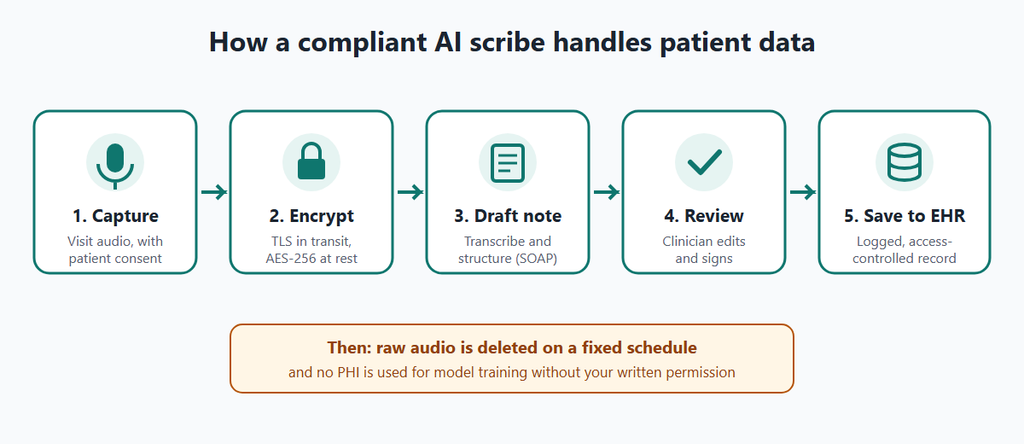
The five stages where PHI moves through an AI scribe, and the safeguard that should apply at each one.
How do they protect patient information?
A well-built scribe uses encryption in transit and at rest, role-based access controls, multi-factor authentication, audit logging, and automatic deletion of raw audio once the note is signed. The same privacy logic applies across care settings; our roundup of AI tools for writing SOAP notes for nurses covers the same privacy questions from the nursing side.
| Data type | Typically collected? | Encrypt? | Recommended retention |
| Voice recordings | Yes | Yes | Delete after note is signed |
| Transcripts | Yes | Yes | Per your records policy |
| Diagnoses and clinical notes | Yes | Yes | Stored in the EHR |
| Patient demographics | Often | Yes | Minimum necessary only |
The 12-Point AI Medical Scribe HIPAA Compliance Checklist
Whether you run a solo practice or a multi-site clinic, these 12 points cover what HIPAA expects when an AI scribe is part of your workflow. Use them to audit your current tool or to vet a new one.
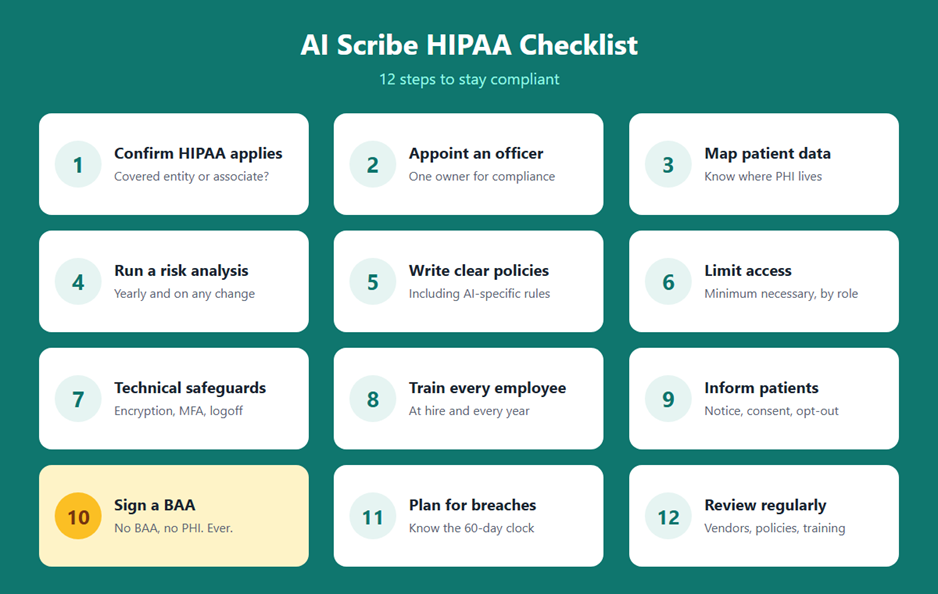
Save or print this 12-point checklist to audit your AI scribe setup.
1. Confirm that HIPAA applies to you
If you are a healthcare provider who bills electronically, a health plan, a clearinghouse, or a vendor working with any of them, HIPAA applies. If your AI scribe touches patient information on behalf of one of these organizations, assume the rules apply to every part of that workflow.
2. Appoint a HIPAA privacy and security officer
HIPAA requires a named person to own privacy and security. In a small practice this can be the office manager or a physician; what matters is that one person tracks policies, vendor agreements and questions so nothing falls through the cracks when you add AI tools.
3. Map where patient data lives
List every place PHI flows: the AI scribe app, its cloud storage, your EHR, email, shared drives, staff phones. Include where the scribe’s audio and transcripts are stored and for how long. You cannot protect data you have not found.
4. Run a security risk analysis
The HIPAA Security Rule requires an accurate and thorough risk analysis (45 CFR 164.308; HHS guidance). HIPAA doesn’t set a fixed schedule, but it expects you to keep it current. Best practice is to repeat it at least once a year and whenever you introduce a new AI tool. The question is simple: where could PHI be exposed, how likely is it, and how bad would it be? Write down the answers and the fixes.
5. Put your policies in writing
Document how staff may and may not use AI tools, which tools are approved, how patient consent is handled, and how notes are reviewed before signing. Good intentions do not hold up in an audit; written, dated policies do.
6. Limit who can see patient data
Apply HIPAA’s minimum necessary standard. Give each person only the access their job requires, set roles inside the AI scribe’s admin console, and remove access the same day someone leaves.
7. Use strong technical safeguards
Look for encryption in transit and at rest, unique user logins, multi-factor authentication, automatic logoff after inactivity, and audit logs you can actually export. Think of it as locking every door in the building, not only the front one.
8. Train every employee
Software cannot prevent every human mistake. HIPAA requires training for everyone who handles PHI when they join and whenever your policies change (45 CFR 164.530(b)). Best practice is a refresher at least once a year, covering what is and is not allowed with AI tools (for example, never pasting patient details into a personal chatbot).
Warning: Many HIPAA incidents are not hacks at all. They are everyday mistakes, such as a note emailed to the wrong address or patient details pasted into an unapproved AI app.
9. Tell patients how their data is used
Update your Notice of Privacy Practices to mention AI-assisted documentation, tell patients when a scribe is listening, and offer a simple way to opt out. Check your state’s recording laws as well: some states require every party’s consent before a conversation is recorded.
10. Sign a Business Associate Agreement with every vendor
Any AI scribe vendor that creates, receives, stores or transmits PHI for you is a business associate and must sign a BAA before it sees real patient data. No BAA means no compliance. Read the agreement closely for subcontractors (such as the AI model provider), data retention, training use and breach notification timelines. HIPAA doesn’t itself forbid a vendor from using your data to train its models. Whether it can depends on what your BAA allows and on HIPAA’s de-identification rules, so ask for a no-training clause in writing.
11. Have a breach-response plan ready
Decide in advance who investigates, who decides whether an incident is a reportable breach, and who notifies patients and regulators. Under the Breach Notification Rule, affected individuals must be notified without unreasonable delay and no later than 60 days after discovery (45 CFR 164.404; HHS Breach Notification Rule).
12. Review and improve on a schedule
Compliance is not a one-time task. As a best practice, re-check your vendors, policies, access lists and training at least once a year, and any time your AI scribe adds new features or integrations.
Common HIPAA Red Flags to Watch For
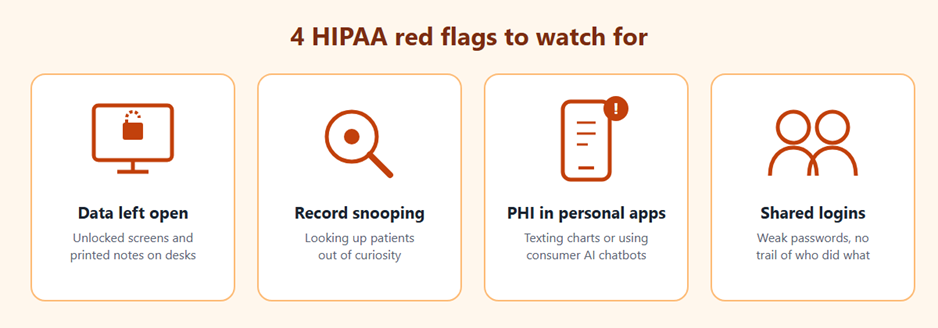
Most HIPAA problems start with everyday habits, not sophisticated attacks.
1. Patient information left in the open
An unlocked workstation or a printed note on the front desk can expose PHI to anyone walking by. Use screen locks and clean-desk rules.
2. Staff snooping on records
Looking up a neighbor’s or celebrity’s chart out of curiosity is a violation even without bad intent. Audit logs make it visible, so review them.
3. Sharing PHI through personal apps
Texting a photo of a chart or pasting a patient’s history into a consumer AI chatbot can expose PHI instantly, with no BAA and no way to pull it back. We explain the rules in detail in Can you put patient data into ChatGPT?
4. Weak passwords and shared logins
When several people use one account, you cannot tell who accessed what. Give everyone a unique login and turn on multi-factor authentication.
Types of AI Medical Scribes by Compliance Level
Not every AI scribe for healthcare offers the same level of protection. Knowing the tiers helps you match a tool to your risk and size.
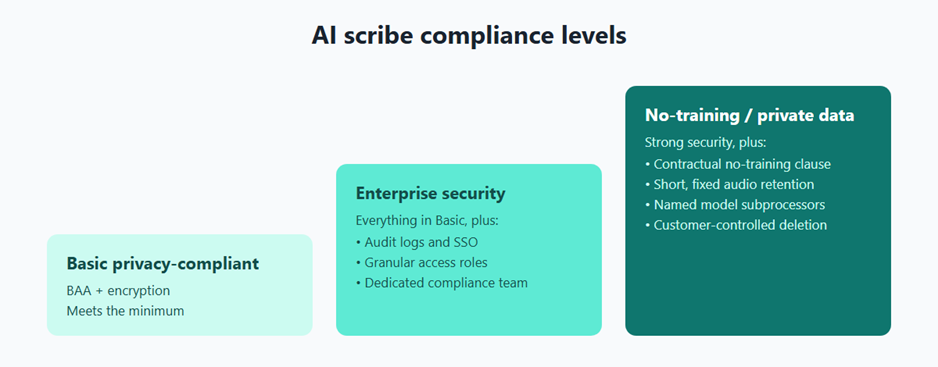
Higher tiers add controls on top of the HIPAA minimum; choose based on your size and risk.
1. Basic privacy-compliant scribes
These meet the minimum: a signed BAA and encryption. They can work well for small practices, as long as you handle access control, training and policies yourself.
2. Enterprise-grade secure scribes
Built for hospitals and larger groups, these add detailed audit logs, single sign-on, granular roles, EHR integration and a dedicated compliance or security team you can contact.
3. No-training, private-data scribes
These put in writing that your patient conversations will never be used to train the underlying AI model, and usually offer short audio retention and customer-controlled deletion. As more AI products quietly reuse customer data, this guarantee is becoming a deciding factor.
How to Evaluate a New AI Scribe Before Adopting It
1. Define the problem you want to solve
Are you trying to cut after-hours charting, improve note quality, reduce transcription costs, or all three? A clear goal makes vendor comparisons faster and more honest.
2. Check privacy and security first
Before demos and pricing, confirm the BAA, encryption, data retention, training policy and the list of subprocessors. If a vendor fails here, nothing else matters. Useful questions to ask:
- Will you sign a BAA before our pilot starts?
- Where is our data stored, and for how long is raw audio kept?
- Is any patient data used to train or improve your models?
- Which third-party AI providers process our data, and are they covered by BAAs?
- Can we export audit logs, and how fast will you notify us of a breach?
3. Pilot it with real workflows
Run the tool through simulated visits first, then a small pilot with consenting patients and a few clinicians. Measure note accuracy, edit time and staff feedback before rolling it out clinic-wide. For a structured approach, see how we tested free AI scribes on role-played consultation notes, or compare AI medical transcription tools under $20.
Benefits of a Compliant AI Scribe, and Risks of a Non-Compliant One
Benefits
- Less time on documentation: clinicians spend less time typing and more time practicing medicine.
- Better patient focus: without a keyboard in the way, you can make eye contact and listen.
- Clearer, more consistent notes: structured AI drafts make charts easier to read and audit later.
Risks of a non-compliant tool
- Data exposure: patient data can be leaked, hacked or reused in ways you never agreed to.
- Legal and financial penalties: HIPAA civil penalties are tiered by culpability. After HHS’s latest inflation adjustment, they can reach $2,190,294 per calendar year for violations of the same requirement (45 CFR 160.404; Federal Register, 28 Jan 2026), on top of state penalties, lawsuits and corrective action plans.
- Lost patient trust: a breach notice is hard to take back, and patients remember it.
Tips for Staying HIPAA Compliant Long-Term
- Track rule changes: HHS proposed major updates to the HIPAA Security Rule in January 2025 (Federal Register, 90 FR 898). As of this update they had not been finalized, so the current rule still applies. Check for changes at least once a year.
- Keep rules simple and visible: a one-page AI use policy that staff actually read beats a long manual nobody opens.
- Train continuously: short, regular refreshers work better than a single orientation session.
To see how we handle data on this site, read our privacy policy.
Sources
- HHS: Guidance on Risk Analysis
- HHS: Business Associates FAQs
- HHS: De-identification of PHI
- HHS: Breach Notification Rule
- eCFR: 45 CFR 164.308 (administrative safeguards), 45 CFR 164.530 (privacy officer, training), 45 CFR 160.404 (penalties)
- Federal Register: Annual Civil Monetary Penalties Inflation Adjustment, 91 FR 3665 (2026)
- Federal Register: Proposed HIPAA Security Rule, 90 FR 898 (2025)
- NEJM AI: Ambient AI Scribes in Clinical Practice: A Randomized Trial (2025)
This article is for general information and is not legal advice. Talk to a qualified healthcare attorney or compliance professional about your specific situation.