Writing report card remarks for 40 students per section, across three or four sections, is one of the most tiring jobs of the term. By student number 30, every remark starts to sound like “Good, but can do better.” These ChatGPT prompts for report card comments help you write specific, kind and honest remarks in a fraction of the time, plus 60 ready-to-edit example comments you can use today.
Who wrote this: I’m a software developer, not a teacher. I built these prompts with the way Indian schools write progress-report remarks in mind (CBSE, ICSE and state boards). You know your students. Use AI for the first draft and your own judgement for the final word.
Why Use ChatGPT for Report Card Remarks?
- Speed: turn your quick notes (“good in maths, talks a lot, improved handwriting”) into a polished remark in seconds.
- Variety: no more copy-pasting the same line for 15 students. Parents compare report cards, and they notice.
- Tone: AI is good at phrasing difficult feedback positively, so you can be honest without hurting a child or upsetting parents.
- Language: it can write the same remark in English and Hindi for parents who prefer it.
First, Protect Your Students’ Privacy
Before you paste anything into ChatGPT, follow one simple rule: never type a student’s full name, roll number, photo, address or any health or family details. Use a placeholder like “Student A” or just the first initial, then add the real name yourself in the school’s report software.
Children’s data needs extra care under India’s Digital Personal Data Protection (DPDP) Act, and many schools have their own rules about AI tools. If your school has a policy, follow it first. Our explainer on what the DPDP Act means when you use ChatGPT covers the basics, and the same thinking applies to student data.
The Formula for a Good Report Card Comment
The best remarks follow a simple “sandwich” that parents understand:
| Part | What it does | Example |
|---|---|---|
| 1. A real strength | Shows you know the child | “Aarav explains science concepts clearly in class discussions.” |
| 2. One area to grow | Specific, not vague | “He needs to show all steps in maths word problems.” |
| 3. A next step | Something the child or parent can do | “Practising two word problems daily at home will help.” |
Keep most remarks to 2 or 3 sentences, or check your school’s word or character limit. Avoid words like “lazy”, “weak” or “careless”. Describe the behaviour instead (“often submits homework late”).
12 ChatGPT Prompts for Report Card Comments
Replace everything in [square brackets]. If you’d rather click than type, our free Teacher Prompt Generator builds these prompts from a few dropdowns.
1. Turn Your Notes Into a Remark
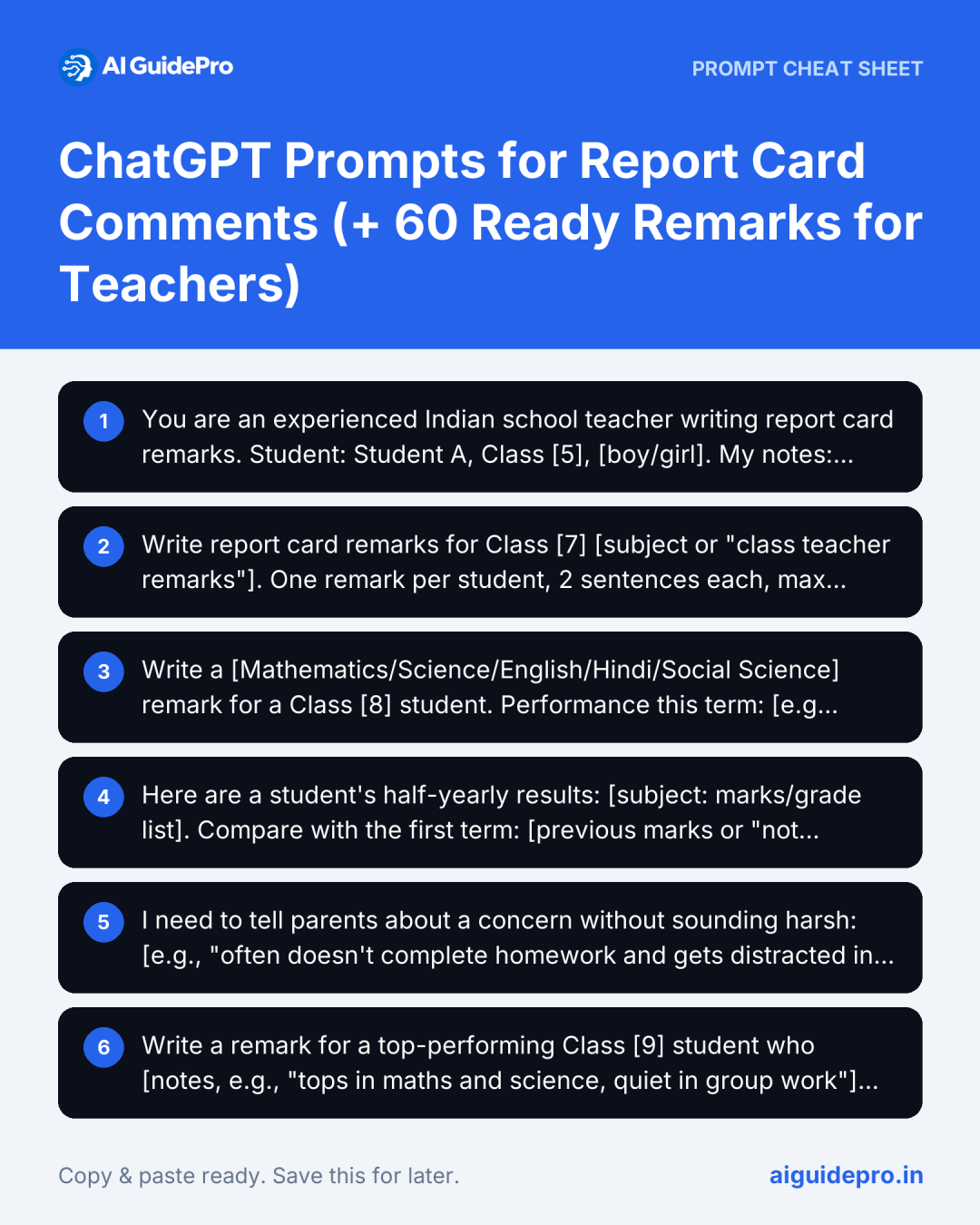
You are an experienced Indian school teacher writing report card remarks.
Student: Student A, Class [5], [boy/girl].
My notes: [e.g., "very good reader, helps classmates, struggles with multiplication tables, handwriting improved a lot this term"].

Write one remark of [2-3 sentences / max 300 characters] that:
- starts with a genuine strength
- mentions one specific area to improve, phrased positively
- ends with a practical suggestion for home
Use simple English that parents can easily understand. Don't exaggerate.
2. Write Remarks for a Whole Class at Once
Write report card remarks for Class [7] [subject or "class teacher remarks"]. One remark per student, 2 sentences each, max [250] characters.
Use the sandwich format (strength, area to grow, next step). Make every remark sound different. Don't reuse the same opening words.

S1: [notes]
S2: [notes]
S3: [notes]
...
Return a table with columns: Student | Remark | Character count.
Tip: Do 8 to 10 students per prompt. With bigger batches, quality drops and remarks start repeating.
3. Subject-Specific Remarks
Write a [Mathematics/Science/English/Hindi/Social Science] remark for a Class [8] student.
Performance this term: [e.g., "scored well in algebra, lost marks in geometry constructions, rarely asks doubts"].
Mention the specific topic names. 2 sentences, positive but honest.
4. Remarks Linked to Marks or Grades
Here are a student's half-yearly results: [subject: marks/grade list].
Compare with the first term: [previous marks or "not available"].
Write a short overall remark that notices the improvement or drop, names the strongest and weakest subject, and suggests one focus for the final exam. Don't mention exact marks.
5. Phrase Difficult Feedback Gently
I need to tell parents about a concern without sounding harsh: [e.g., "often doesn't complete homework and gets distracted in class"].
Write 3 different versions of a respectful, constructive remark (2 sentences each). Focus on behaviour, not personality, and include what the school and parents can do together.
6. Remarks for High Achievers
Write a remark for a top-performing Class [9] student who [notes, e.g., "tops in maths and science, quiet in group work"].
Praise specifically (not just "excellent"), and suggest a stretch goal so the student keeps growing, like leadership, olympiads or helping peers.
7. Remarks for Students Who Are Struggling
Write an encouraging remark for a Class [4] student who is finding [reading/maths/writing] difficult but [one positive, e.g., "tries hard and is always polite"].
The remark should give hope, name one small achievable target for the next term, and invite parents to meet the teacher if they wish. 2-3 sentences.
8. Co-Scholastic and Behaviour Remarks
Write short remarks (1 sentence each) for the co-scholastic section of a Class [6] report card for this student:
- Work education: [notes]
- Art education: [notes]
- Health and physical education: [notes]
- Discipline / values: [notes]
Keep them specific and positive.
9. Pre-Primary and Primary (Simple, Warm Remarks)
Write a warm report card remark for a [UKG/Class 1] child. Notes: [e.g., "recognises all letters, loves rhymes, finds it hard to share toys, settling in well"].
Use very simple words, mention play and social skills, not just academics. 2 sentences.
10. Remarks in Hindi
नीचे दी गई जानकारी के आधार पर कक्षा [5] के छात्र के लिए रिपोर्ट कार्ड पर 2 वाक्यों की सकारात्मक टिप्पणी सरल हिंदी में लिखिए। पहले एक खूबी, फिर सुधार का एक क्षेत्र और घर के लिए एक सुझाव।
जानकारी: [नोट्स]
11. Make Remarks Less Repetitive
Here are the remarks I wrote for my class: [paste remarks].
Find any that sound too similar or generic and rewrite only those, so each one feels personal. Keep the meaning, length and tone the same. Mark the ones you changed.
12. Fit a Character Limit
Shorten each of these remarks to under [150] characters without losing the strength and the improvement area. Show the new character count for each.
[paste remarks]
60 Ready-to-Use Report Card Comments
Use these as starting points. Change the name and add one detail only you would know, so each remark still sounds personal.
Excellent Performance
- [Name] shows a deep understanding of concepts and often explains them to classmates. Taking part in olympiads or quizzes would be a great next challenge.
- [Name] is a curious learner who asks thoughtful questions. Keep reading beyond the textbook to build on this strong start.
- [Name]’s written work is neat, accurate and always on time. Taking a leadership role in group activities will help [him/her] grow further.
- [Name] has performed consistently well in all subjects this term. Well done! Aim to share ideas more often in class discussions.
- [Name] solves problems creatively and shows excellent reasoning in mathematics. Exploring puzzles and logic games at home will keep this spark alive.
- [Name] writes with rich vocabulary and clear ideas. Keeping a weekly journal will polish these skills even more.
- [Name] is a self-motivated student who sets high standards. Remember to take breaks and enjoy the learning journey.
- [Name]’s project work shows excellent research and presentation skills. Keep up this wonderful effort.
- [Name] grasps new topics quickly and applies them with confidence. Helping peers who find topics difficult will deepen [his/her] own understanding.
- [Name] is attentive, well-prepared and a pleasure to teach. Continue this excellent attitude in the next term.
Good Performance, Room to Grow
- [Name] understands concepts well in class. Revising regularly at home will help turn this understanding into better test scores.
- [Name] participates actively and enjoys group work. Paying closer attention to spelling and presentation will make [his/her] work even better.
- [Name] has shown steady progress this term. Practising maths word problems daily will build more confidence.
- [Name] reads fluently and with expression. Writing answers in complete sentences is the next step to focus on.
- [Name] is capable of excellent work when focused. Completing class work within time will help [him/her] reach full potential.
- [Name] has a good grasp of science concepts. Learning key definitions and diagrams thoroughly will improve exam answers.
- [Name] is cheerful and cooperative. Asking doubts in class without hesitation will help [him/her] learn faster.
- [Name] has improved in [subject] this term. Continued practice at home will keep this progress going.
- [Name] brings good ideas to discussions. Organising these ideas clearly in written answers is the next goal.
- [Name] works sincerely. Reading for 20 minutes daily will strengthen vocabulary and comprehension.
Needs Improvement (Encouraging)
- [Name] is a polite and willing learner. With regular practice of basic [maths facts / reading], [he/she] will gain confidence next term.
- [Name] has the ability to do well. Completing homework regularly and on time will make a big difference.
- [Name] tries hard in class. Short daily revision at home, with parental support, will help [him/her] keep up with new topics.
- [Name] is creative and full of ideas. Focusing during lessons and avoiding distractions will help [him/her] learn better.
- [Name] needs more practice with [handwriting / spelling / tables]. Ten minutes of daily practice will bring visible improvement.
- [Name] has shown small improvements this term. Let’s build on them together. I’d be happy to meet parents to plan the next steps.
- [Name] understands more than [his/her] marks show. Practising written answers will help [him/her] express this knowledge in exams.
- [Name] is friendly and well-liked. More regular attendance will help [him/her] keep pace with the class.
- [Name] is capable but often rushes through work. Checking answers before submitting will reduce avoidable mistakes.
- [Name] should ask for help when stuck instead of leaving questions blank. The teachers are always happy to help.
Behaviour and Attitude
- [Name] is respectful, kind and helpful to everyone in class.
- [Name] follows class rules and sets a good example for others.
- [Name] works well in teams and listens to others’ ideas.
- [Name] is energetic and enthusiastic. Learning to wait for [his/her] turn to speak will make discussions better for everyone.
- [Name] is becoming more confident in class and has started sharing ideas. Great progress!
- [Name] takes responsibility for [his/her] belongings and class duties.
- [Name] is quiet and attentive. Speaking up more often will help others benefit from [his/her] good ideas.
- [Name] shows good leadership as class monitor and handles responsibility maturely.
- [Name] needs to be more careful about completing tasks on time. A simple daily checklist can help.
- [Name] is always punctual, neatly dressed and ready to learn.
Subject-Specific
- Maths: [Name] is quick with calculations. Showing all steps in word problems will earn full marks.
- Maths: [Name] should practise tables and mental maths daily to build speed and confidence.
- Science: [Name] enjoys experiments and observes carefully. Writing neat, labelled diagrams is the next goal.
- Science: [Name] understands concepts but should learn scientific terms accurately.
- English: [Name] speaks confidently. Reading storybooks regularly will improve grammar and vocabulary.
- English: [Name]’s creative writing is imaginative. Paying attention to punctuation will make it shine.
- Hindi: [Name] reads Hindi fluently. Practising matras in writing will improve accuracy.
- Social Science: [Name] remembers facts well. Using maps and timelines will help connect events.
- Computer: [Name] learns new software quickly and helps classmates with tasks.
- Art: [Name] uses colour creatively and takes pride in finishing artwork neatly.
Pre-Primary and Early Years
- [Name] has settled happily into school and enjoys rhymes and stories.
- [Name] recognises letters and numbers well. Reading picture books together at home will help.
- [Name] is learning to share and take turns, and is making new friends.
- [Name] enjoys colouring and is developing a steady pencil grip.
- [Name] follows simple instructions and takes part eagerly in activities.
- [Name] is curious and asks lots of questions. Wonderful!
- [Name] expresses feelings with words and is growing in confidence.
- [Name] enjoys outdoor play and shows good balance and coordination.
- [Name] is becoming more independent with tiffin, shoes and bag.
- [Name] listens attentively during story time and can retell simple stories.
Words to Use (and Avoid) in Report Card Remarks
| Instead of… | Try… |
|---|---|
| Lazy | Needs encouragement to complete tasks |
| Weak in maths | Is building confidence in [topic] |
| Careless | Can improve by checking work before submitting |
| Talkative / disturbs class | Is social and energetic; is learning when to listen |
| Slow learner | Benefits from extra practice and time |
| Average | Shows steady progress |
| Good | Name exactly what was good: “explains answers clearly” |
A 30-Minute Workflow for a Whole Section
- 5 minutes: in a spreadsheet, jot 3 to 5 words of notes per student (S1, S2, S3…, no names).
- 10 minutes: paste 10 students at a time into prompt 2.
- 5 minutes: run prompt 11 on the full list to remove repetition.
- 10 minutes: read every remark, fix anything that isn’t true, add names in your school software.
For more ways to save time this term, see the Education & Teaching AI Starter Kit, our 20 ChatGPT prompts for CBSE lesson plans, and the best free AI tools for teachers in India.
Frequently Asked Questions
Is it okay for teachers to use ChatGPT for report card comments?
Yes, as long as you use your own observations as the input, check every remark, and follow your school’s rules on AI and student data. The judgement about the child stays yours; AI only helps with wording.
Will parents know the remarks were written with AI?
Not if each remark includes a real, specific detail about their child. Generic remarks sound robotic whether a person or AI writes them. The notes you give the prompt are what make the remark personal.
Which is better for remarks: ChatGPT, Gemini or Claude?
All three free versions handle these prompts well. Use whichever your school allows. Gemini may already be available in your school’s Google Workspace account.
How long should a report card remark be?
Usually 2 to 3 sentences, or whatever your school’s report software allows. Prompt 12 trims remarks to any character limit.
Final Thoughts
Good report card remarks tell parents three things: what their child does well, what to work on, and how they can help. ChatGPT can’t observe your students, but it can turn your quick notes into clear, kind and varied remarks in minutes. Keep names out of the prompt, check every line, and spend the time you save on what matters most: teaching.
Bookmark this page for the next report card season, and try the free Teacher Prompt Generator for lesson plans, quizzes and feedback too.