Nursing care plans take hours, and in nursing school you write a lot of them. ChatGPT can’t replace your clinical judgement or your instructor’s format, but it can help you organise assessment data, phrase nursing diagnoses, write SMART goals and find rationales faster. This guide gives nursing students and new nurses 15 ChatGPT prompts for nursing care plans, a worked example, and clear rules for using AI safely.
Who wrote this, and an important note: I’m a software developer, not a nurse or nurse educator. This article is for learning and study support only. It is not medical advice. Always follow your school’s care plan format, your facility’s policies and your instructor or preceptor. Verify every diagnosis, intervention and rationale against your textbook, NANDA-I resources and current evidence.
The Golden Rule: No Real Patient Data
Never paste a patient’s name, date of birth, record number, room number, photos or any detail that could identify them into ChatGPT or any public AI tool. In the US this can breach HIPAA, and similar privacy laws apply in the UK, EU, Canada, Australia and elsewhere. Your school or employer may also ban it outright.
Use a de-identified or made-up case instead: “68-year-old patient, post-op day 1 after hip replacement” is fine. A real name with a real bed number is not.
Our guide Can you put patient data into ChatGPT? explains the privacy rules in more detail.
Quick Refresher: The Parts of a Nursing Care Plan
Most programmes follow the nursing process, often remembered as ADPIE:
| Step | What you write | Where AI can help |
|---|---|---|
| Assessment | Subjective and objective data | Organising and clustering your data |
| Diagnosis | Nursing diagnosis (often NANDA-I format) | Suggesting possible diagnoses to check |
| Planning | Patient-centred, measurable (SMART) goals | Rewriting goals so they’re measurable |
| Implementation | Nursing interventions with rationales | Drafting interventions and explaining why |
| Evaluation | Was the goal met, partly met or not met? | Phrasing evaluation statements |
A typical diagnostic statement in PES format reads: Problem related to Etiology as evidenced by Signs and symptoms.
15 ChatGPT Prompts for Nursing Care Plans
Assessment and Diagnosis
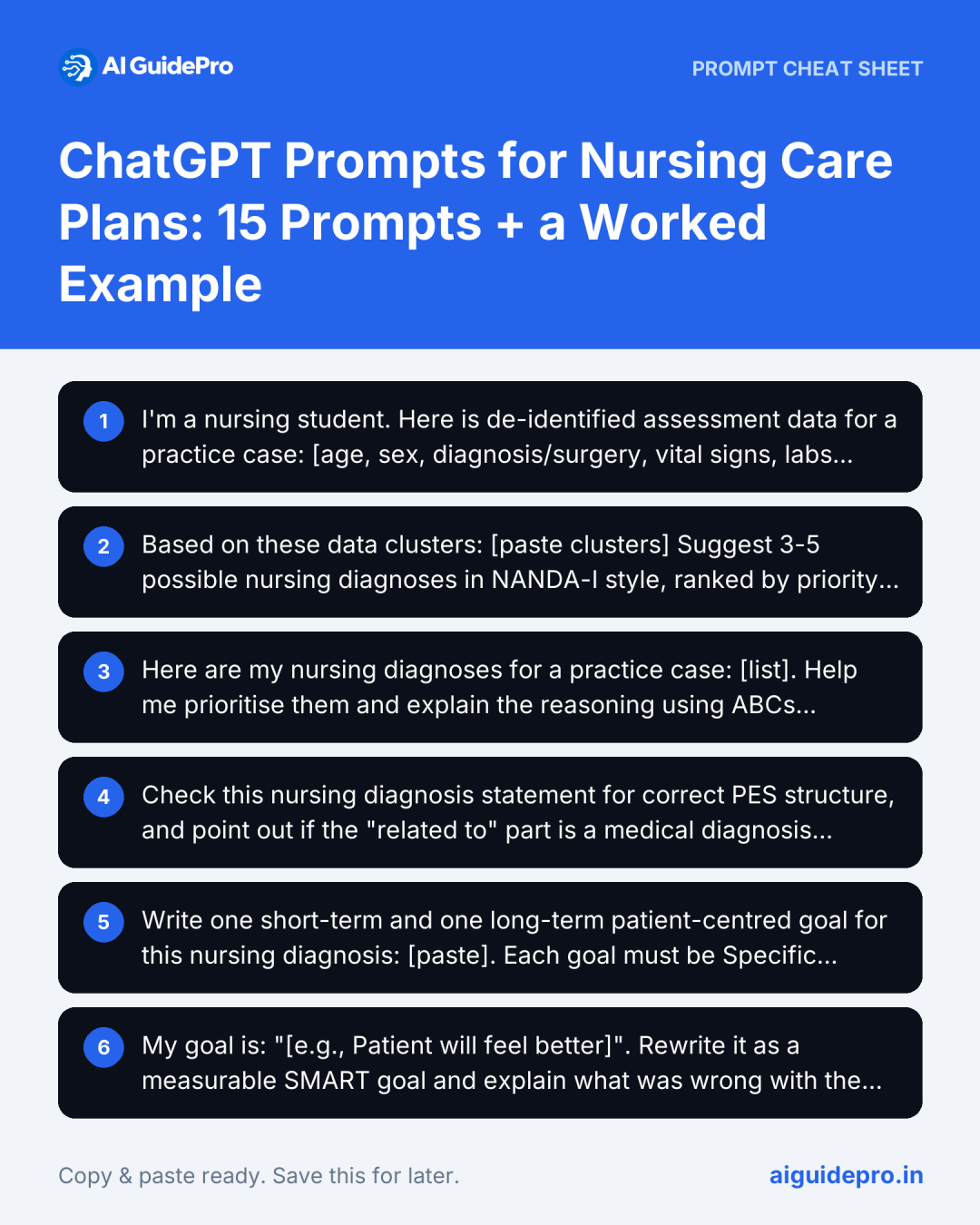
1. Organise Assessment Data
I'm a nursing student. Here is de-identified assessment data for a practice case:
[age, sex, diagnosis/surgery, vital signs, labs, subjective statements, objective findings]

Sort this into subjective and objective data, then group related findings into clusters (e.g., pain, mobility, breathing, infection risk). Don't add any data I haven't given you.
2. Suggest Possible Nursing Diagnoses
Based on these data clusters: [paste clusters]
Suggest 3-5 possible nursing diagnoses in NANDA-I style, ranked by priority (consider ABCs and Maslow). For each, write a PES statement using only the data provided.
Note which ones are actual problems vs. risk diagnoses. I will verify these against my NANDA-I reference.
Check every label: AI tools sometimes produce diagnosis labels that look official but aren’t in the current NANDA-I list. Confirm each one in your approved reference.
3. Prioritise Diagnoses
Here are my nursing diagnoses for a practice case: [list].
Help me prioritise them and explain the reasoning using ABCs (airway, breathing, circulation), Maslow's hierarchy and actual vs. risk problems.
4. Check My PES Statement
Check this nursing diagnosis statement for correct PES structure, and point out if the "related to" part is a medical diagnosis (which my instructor doesn't allow) or if the evidence doesn't match: [paste statement]Goals and Outcomes
5. Write SMART Goals
Write one short-term and one long-term patient-centred goal for this nursing diagnosis: [paste].
Each goal must be Specific, Measurable, Achievable, Relevant and Time-bound, and start with "The patient will…".
6. Fix a Vague Goal
My goal is: "[e.g., Patient will feel better]". Rewrite it as a measurable SMART goal and explain what was wrong with the original.Interventions and Rationales
7. Interventions With Rationales
For the nursing diagnosis [paste PES statement] and goal [paste goal], list 6 nursing interventions: 2 assessment, 2 therapeutic, 2 education.
For each, give a short evidence-based rationale. Mark any intervention that would need a provider order. Format as a table: Intervention | Rationale | Type.
8. Explain a Rationale Simply
Explain in simple terms why this intervention works, as if teaching a first-year nursing student: [intervention]. Then give me the textbook-style rationale in one sentence.9. Patient Education Plan
Create a patient education plan for [topic, e.g., incentive spirometer use / new insulin regimen] for an adult with [reading level/language needs]. Include key teaching points, teach-back questions, and how I'd evaluate understanding.Evaluation and Documentation
10. Evaluation Statements
Write evaluation statements for this goal: [goal]. Give one example each for "goal met", "goal partially met" and "goal not met", with the data that would support each.11. Turn the Plan Into a Table
Format this care plan into a clean table with columns: Assessment data | Nursing diagnosis | Goal | Interventions | Rationale | Evaluation. Don't change any clinical content. [paste plan]Study and Exam Practice
12. Practice Case Generator
Create a realistic, fictional practice case for a [med-surg / paediatric / maternal / mental health] nursing care plan. Include vital signs, relevant labs and subjective/objective data. Don't give me the answers. I'll write the care plan and ask you to review it.13. Review My Care Plan
Act as a strict nursing clinical instructor. Review my care plan for this practice case and give feedback on: diagnosis accuracy, PES structure, SMART goals, intervention-rationale match, and priority. Don't rewrite it for me; tell me what to fix.
Case: [paste]
My plan: [paste]
14. Concept Map Outline
Turn this practice case into a concept map outline: central medical diagnosis, linked nursing diagnoses, supporting data for each, and connections between them. [paste case]15. NCLEX-Style Questions
Write 5 NCLEX-style questions (including select-all-that-apply and prioritisation) based on this nursing diagnosis and its interventions: [paste]. Show answers and rationales only after I answer.Worked Example: Post-Operative Pain
Here is how a short, fictional case comes together. Your programme’s format and expectations come first; use this only to see how the parts connect.
| Part | Example |
|---|---|
| Case | Fictional 62-year-old, post-op day 1 after knee replacement. Rates pain 7/10, grimaces when moving, guards the right leg, BP 148/90, HR 98. |
| Nursing diagnosis | Acute pain related to surgical tissue trauma as evidenced by pain rating of 7/10, guarding of the right leg and facial grimacing. |
| Short-term goal | The patient will report pain at or below 3/10 within 1 hour of receiving the prescribed analgesic. |
| Interventions | 1) Assess pain with a standard scale before and after interventions. 2) Give prescribed analgesia as ordered and on time. 3) Reposition and support the leg with pillows. 4) Use cold therapy if ordered. 5) Teach the patient to report pain early. |
| Rationales | 1) Gives a baseline and measures effect. 2) Steady analgesia supports comfort and mobility. 3) Reduces strain on the incision. 4) Cold can reduce swelling and pain. 5) Early treatment is usually more effective. |
| Evaluation | Goal met: patient rated pain 3/10 one hour after analgesia and moved with less guarding. |
This example is illustrative and simplified for learning. Real care plans depend on the individual patient, provider orders and local protocols.
Mistakes to Avoid When Using AI for Care Plans
- Using a medical diagnosis as the “related to”. Many instructors reject “related to diabetes”. Prompt 4 helps you catch this.
- Trusting rationales without checking. AI can sound confident and still be wrong or out of date.
- Copying the whole plan. Many schools treat this as academic misconduct. Use AI to learn and check, not to submit its work as yours.
- Generic interventions. “Monitor patient” isn’t an intervention. Ask what, how often and why.
- Pasting real patient details. Always de-identify, or better, use fictional cases.
More AI help for nurses: our Nursing & Allied Health AI Starter Kit, the top AI tools for writing SOAP notes, and our guide to writing discharge summaries with ChatGPT.
Frequently Asked Questions
Can I use ChatGPT to write my nursing care plan?
You can use it to organise data, check structure and understand rationales, if your school allows it. Many programmes don’t allow submitting AI-written work as your own, so check your academic integrity policy and treat AI as a study aid.
Is ChatGPT accurate for nursing diagnoses?
It’s often helpful but not reliable enough to trust alone. It may suggest outdated or non-standard labels and generic rationales. Always verify against current NANDA-I references and your textbook.
Is it safe to put patient information into ChatGPT?
Not if it can identify the patient. Use fictional or fully de-identified cases. Many hospitals ban using public AI tools with any patient data.
What is the best AI for nursing students?
ChatGPT, Claude and Gemini can all help with study tasks like these. Some schools provide approved tools; prefer those if available.
Can AI help me study for the NCLEX?
Yes. Prompt 15 creates practice questions with rationales. Use them alongside an official or well-reviewed NCLEX prep resource, since AI questions can contain errors.
Final Thoughts
Care plans teach you to think like a nurse: gather data, find the priority problem, set a measurable goal and choose interventions you can justify. ChatGPT can speed up the paperwork and act as a patient study partner, but the clinical reasoning has to be yours. Keep patient data out of it, verify everything, and use the review prompts to sharpen your own work.