A good product description does two jobs at once: it helps shoppers decide to buy, and it helps search engines understand what you sell. Writing them for 10 products is fine. Writing them for 300 is where most store owners give up and paste the manufacturer’s text. These ChatGPT prompts for product descriptions help you write unique, benefit-led copy for Shopify, Amazon, Etsy or any online store, with examples and a simple process you can repeat for every product.
Who wrote this: I’m a software developer, not a full-time copywriter. I’ve built product pages and tested these prompts on real catalogue data. Your brand voice and your customers matter more than any prompt, so always edit the output.
What a High-Converting Product Description Includes
| Element | What to write | Example (insulated water bottle) |
|---|---|---|
| Hook | One line on the main benefit | “Ice-cold water for 24 hours, even in a hot car.” |
| Who it’s for | The buyer and the moment | “Built for gym days, hikes and long commutes.” |
| Benefits, then features | What it does for them, then the spec that proves it | “No sweaty bag: double-wall steel stops condensation.” |
| Details | Size, materials, care, what’s in the box | “750 ml · 18/8 stainless steel · dishwasher-safe lid” |
| Objection killer | Warranty, returns, sizing help | “Lifetime warranty against leaks.” |
ChatGPT is very good at turning a dry spec sheet into this structure. What it can’t do is know your product: it will invent features if you don’t give it the facts. So every prompt below starts with your real product details.
Step 1: Build a Product Fact Sheet
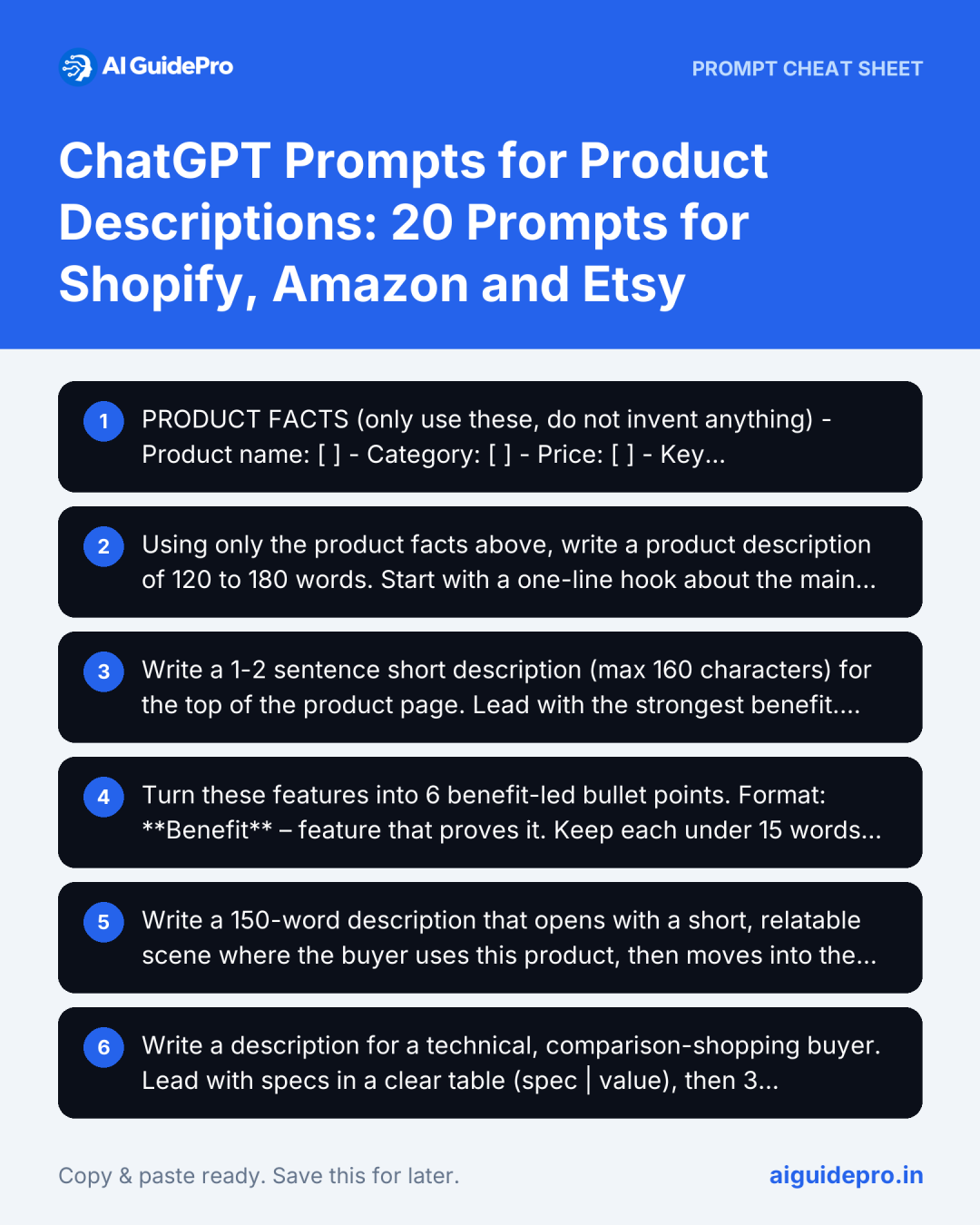
PRODUCT FACTS (only use these, do not invent anything)
- Product name: [ ]
- Category: [ ]
- Price: [ ]
- Key features/specs: [materials, size, weight, capacity, compatibility]
- What's included: [ ]
- Who it's for: [ ]
- Main problem it solves: [ ]
- What makes it different from cheaper options: [ ]
- Care / warranty / returns: [ ]
- Brand voice: [e.g., friendly and playful / premium and minimal / technical and precise]
- Target keyword: [e.g., "insulated water bottle 750ml"]
If you’d rather fill in a form, our free Product Description Prompt Generator builds this for you.
20 ChatGPT Prompts for Product Descriptions
Core Descriptions
1. The All-Purpose Product Description
Using only the product facts above, write a product description of 120 to 180 words.
Start with a one-line hook about the main benefit. Then a short paragraph on who it's for. Then 4-5 bullet points that each pair a benefit with the feature that proves it. End with one line that removes a buying worry (warranty, returns, sizing).
Use the target keyword naturally once in the first two sentences. No clichés like "elevate", "game-changer" or "must-have".
2. Short Description (Above the Fold)
Write a 1-2 sentence short description (max 160 characters) for the top of the product page. Lead with the strongest benefit. Use the product facts only.3. Benefit Bullets Only
Turn these features into 6 benefit-led bullet points. Format: **Benefit** – feature that proves it. Keep each under 15 words.
Features: [paste features]
4. Storytelling Description
Write a 150-word description that opens with a short, relatable scene where the buyer uses this product, then moves into the key benefits and specs. Brand voice: [voice]. Facts only.5. Technical Buyer Version
Write a description for a technical, comparison-shopping buyer. Lead with specs in a clear table (spec | value), then 3 sentences on why those specs matter in real use. No hype words.Marketplace-Specific
6. Amazon Title and Bullets
Write an Amazon listing for this product:
- A title under 200 characters (brand, product type, key feature, size/quantity, colour)
- 5 bullet points, each starting with a short capitalised benefit phrase, under 250 characters each
- A product description paragraph
Follow Amazon's style: no promotional claims like "best seller", no prices, no emojis.
Check the rules: Amazon’s title and bullet limits vary by category and change over time. Confirm in Seller Central before you publish.
7. Etsy Listing
Write an Etsy listing for this handmade/vintage product: a title that front-loads the main search phrase, a warm 150-word description that mentions how it's made and the story behind it, and 13 tags (max 20 characters each).8. Shopify SEO Fields
Write the Shopify SEO fields for this product: page title (under 60 characters, keyword first), meta description (under 155 characters, benefit + call to action) and a short URL handle.9. Google Shopping Title
Write 3 Google Shopping product titles under 150 characters using the order: Brand + Product type + Key attributes (size, colour, material) + Model. Put the most important words in the first 70 characters.Scaling to a Whole Catalogue
10. Bulk Descriptions From a Spreadsheet
Below are rows from my product spreadsheet (name | features | price | audience).
For each row, write a 60-80 word description and 3 benefit bullets in the same brand voice: [voice].
Return a table: Product | Description | Bullets. Don't invent features.
[paste 10 rows]
Tip: Work in batches of about 10 rows. Larger batches make the copy more repetitive and errors harder to spot.
11. Variations Without Duplicate Content
These 5 products are very similar (different colours/sizes): [paste].
Write a unique description for each that highlights what makes that variant right for a specific buyer, so the pages aren't near-duplicates.
12. Rewrite Manufacturer Copy
Rewrite this manufacturer description in our brand voice: [voice]. Make it benefit-led, cut jargon, and keep every fact accurate. Don't copy any full sentence.
[paste manufacturer text]
Improving What You Have
13. Conversion Critique
Act as a conversion copywriter. Review this product description and list: unclear benefits, missing information a buyer would want, weak words, and anything that sounds generic. Then rewrite it.
[paste description]
14. Answer Buyer Questions
Here are customer questions and reviews for this product: [paste].
Find the 5 most common concerns and write short FAQ answers to add to the product page, using only the facts provided.
15. Address Objections
List the top 5 reasons someone might hesitate to buy this product at [price]. For each, write one sentence for the description that addresses it honestly.16. Tone Variations
Rewrite this description in 3 tones: playful, premium/minimal, and practical/no-nonsense. Keep length and facts the same. [paste]17. Translate and Localise
Translate this product description into [language] for shoppers in [country]. Adapt units, sizes and idioms so it reads naturally, not word-for-word. [paste]Extras for the Product Page
18. Product FAQ Section
Write 6 FAQs with short answers for this product page, covering sizing/fit, care, compatibility, shipping and returns. Only use the facts provided; mark any answer you can't confirm as [CHECK].19. Image Alt Text
Write descriptive alt text (under 125 characters) for these product photos: [describe each photo]. Include the product name and key attribute naturally.20. Social Post From the Description
Turn this product description into an Instagram caption (with 5 relevant hashtags) and a short X/Twitter post. [paste]Before and After Example
Manufacturer copy: “Stainless steel vacuum flask. Capacity 750ml. Double wall. Keeps cold 24h, hot 12h. BPA free lid.”
After prompt 1:
Ice-cold water for 24 hours, even after a day in a hot car.

This 750 ml insulated bottle is built for gym sessions, long hikes and all-day desk hydration.

- No sweaty bags: double-wall steel stops condensation outside
- Hot drinks stay hot: coffee stays warm for up to 12 hours
- Safe to sip: BPA-free, leak-proof lid
- Fits your routine: slim enough for most car cup holders

Backed by a lifetime warranty against leaks.
The “fits most cup holders” line only belongs there if it’s true for your product. Every claim in the final copy must come from your fact sheet.
SEO Tips for Product Descriptions
- Write unique copy for every product. Manufacturer text appears on dozens of sites, so it gives search engines little reason to rank yours.
- Use one main keyword per product in the title, first sentence and meta description, and write naturally around it.
- Add product structured data (price, availability, reviews). Most store platforms do this automatically; check it with Google’s Rich Results Test.
- Answer real questions on the page. FAQs help shoppers and can match long-tail searches.
- Don’t make claims you can’t back up. Health, eco and “best” claims can break advertising rules in many countries.
For more e-commerce writing help, try our Copywriting Prompt Generator and Social Media Prompt Generator. Need better product photos too? See our best AI image editors.
Frequently Asked Questions
Can I use ChatGPT for product descriptions on Shopify or Amazon?
Yes. Many sellers do. Give it accurate product facts, follow each marketplace’s rules, and edit the output so it sounds like your brand and contains no invented claims.
Does Google penalise AI-written product descriptions?
Google’s guidance focuses on whether content is helpful and original, not on how it was produced. Thin, duplicated or misleading descriptions are the real risk, whoever writes them.
How long should a product description be?
Usually 100 to 300 words for most products: enough for benefits, specs and buyer questions. Complex or expensive products can justify more.
How do I avoid duplicate content across similar products?
Write a unique angle for each variant (prompt 11), add variant-specific details, and use canonical tags or a single product with variants where your platform supports it.
Which AI is best for product descriptions?
ChatGPT, Claude and Gemini all handle these prompts well. The quality of your product facts and your editing matter more than the model.
Final Thoughts
ChatGPT won’t replace knowing your product and your customer, but it removes the blank-page problem. Build a fact sheet, start with prompt 1, run the result through the critique prompt, and work through your catalogue in small batches. Unique, benefit-led descriptions help shoppers buy and help search engines understand what you sell.