


It’s 11:47 p.m. A factory fire has just broken out, and the editor wants 600 words by 1 a.m. The reporter on duty has three voice memos, a page of messy notes and an AI writing assistant open in the next tab.
That AI tool can save her an hour. It can also slip one made-up “fact” into her story and put her paper’s name at risk. Which way it goes depends on one thing: how she uses it.
That small scene sums up where journalism stands today. For years, “newsroom productivity” simply meant getting more stories out in less time. Now AI is moving deeper into how news is gathered, processed, written and shared. The real question isn’t whether AI makes newsrooms faster. It’s what newsrooms do with the extra time and capacity it creates.
AI + HI: The Partnership That Really Matters
At its heart, this is a question of editorial responsibility.
AI can process huge amounts of information in seconds. But journalism also needs HI, or Human Intelligence. That means the context, empathy, ethical judgment and accountability that only people can bring.
Think of AI as a powerful engine and HI as the driver. The engine gives you speed. The driver decides where to go, when to brake and who’s responsible if something goes wrong.
| AI Brings | HI (Human Intelligence) Brings |
|---|---|
| Speed and scale | Context and meaning |
| Pattern spotting across huge data sets | Judgment about what actually matters |
| Fast drafts, summaries and translations | Empathy for the people in the story |
| Round-the-clock processing | Ethics and accountability to the public |
Working together, AI and HI can deliver news that’s faster, more accurate and more useful. But one rule stays fixed: journalists remain responsible for everything that reaches the public.
New to these tools? Start with our guide on what AI writing tools are and how they work.
Moving Journalists Closer to the Work Only They Can Do
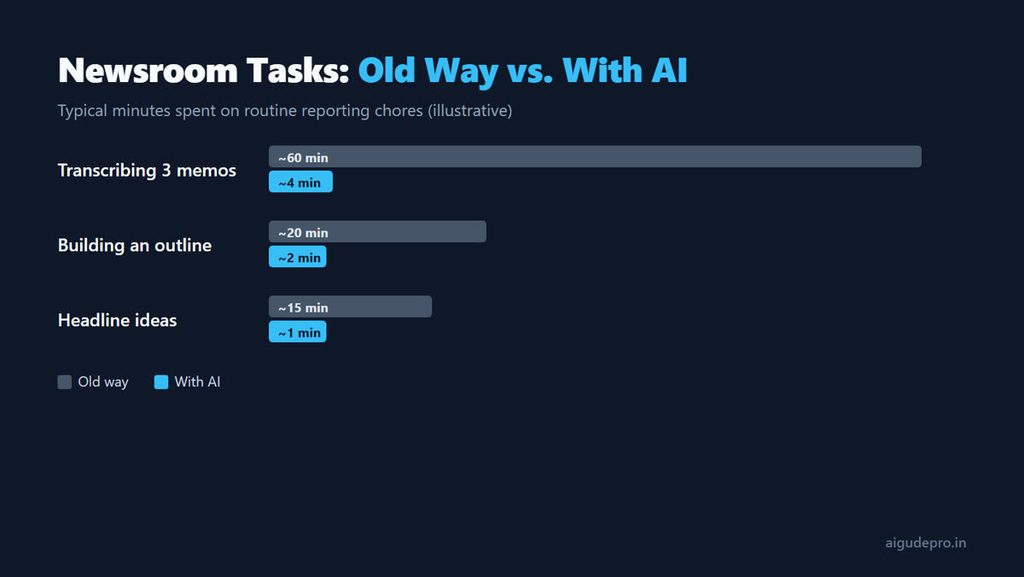
Here’s a secret about journalism: a lot of it isn’t glamorous. Much of a reporter’s day goes into work that’s important but repetitive, such as:
- Searching through public records
- Transcribing long interviews
- Summarizing reports and documents
- Translating material
- Preparing several versions of the same story for print, web and social media
Picture what happens before a big story reaches the editor’s desk. A reporter might have hundreds of pages of documents to read, hours of interviews to transcribe and a dozen sources to cross-check. That’s days of work before a single good sentence gets written.

This is where AI shines. It can take on that mechanical load, so reporters get more time for the parts of the job that need a human being:
- Interviewing sources face to face
- Chasing new leads
- Checking evidence
- Explaining what the facts actually mean for readers
A Lead Is Not a Story
The African Investigative Journalism Conference 2025 explored how AI can help with investigations and document analysis, using tools built for African journalists. The most important lesson was about what happens after the machine finds something.
Say an AI tool spots the same name popping up across hundreds of documents. That’s exciting, but it’s only a lead. A journalist still has to figure out why that name matters, test it against real evidence and find the missing pieces. AI points the flashlight. The reporter still has to walk into the room.

What Big Newsrooms Allow AI to Do
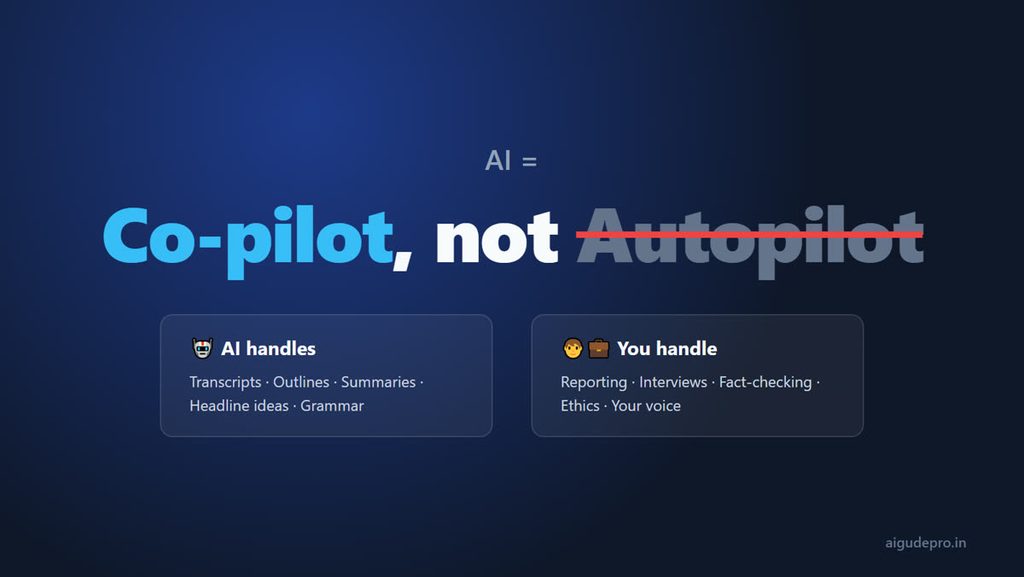
The Associated Press draws the same line in its AI standards, which it updated in July 2026. Here’s the split in simple terms:
| ✅ AI Can Assist With | 🧑💼 Stays With Journalists |
|---|---|
| Research | Sourcing |
| Document summaries | Verification |
| Transcription and translation | Editorial decisions |
| Headline suggestions | Final responsibility for what’s published |
The takeaway? Don’t judge AI by how many tasks it completes. Judge it by how much better the journalism gets once those tasks are off your plate.
💡 Pro Tip: Always tell AI what not to do. A prompt like “Organize these notes into a news outline. Use only the facts I provide, and flag anything that’s unclear” cuts down on made-up details.
Want more prompts like this? Check out our collection of ChatGPT prompts for content writers.
India’s Next Big Opportunity: Multilingual Journalism
For India, one of the most exciting uses of AI may be in distribution, meaning how news reaches people.
Imagine one well-reported, fact-checked story. With AI’s help, it could quickly become:
- Versions in Hindi, Marathi, Tamil and Bengali
- A television script
- An audio or podcast version
- A short summary for mobile readers
- Posts for social media

This isn’t just an idea. At the JournalismAI Festival 2025, Scroll’s AI Lab showed its work on Factivo, a platform being built to repurpose journalism across different formats.
That could make news in regional languages faster and easier to access for millions of readers.
Why Word-for-Word Translation Isn’t Enough
Language is more than swapping one word for another. A translation can be technically correct and still:
- Lose a cultural reference
- Change the tone of what someone said
- Miss the meaning of a local saying or expression
Think of a politician’s sarcastic remark in Marathi. Translated literally into English or Tamil, it might read like a serious promise. The words are right, but the meaning is wrong.
That’s why human language editors will stay essential. Their job is to make sure every automated version stays true to the original reporting, its context and the people in the story.
In the end, this is about access. Technology should help verified news travel further, without its meaning getting lost along the way.
📝 Tip: If you publish in more than one language, have a native speaker review every AI translation, especially quotes, idioms and headlines.
As AI Grows, Editorial Trust Matters More
Here’s where the excitement about AI needs a reality check.
A major study by the European Broadcasting Union (EBU) and the BBC, called News Integrity in AI Assistants, tested more than 3,000 AI answers about news across 18 countries and 14 languages. The results were eye-opening:
- 45% had at least one significant issue
- 31% had serious sourcing problems
- 20% had major accuracy issues
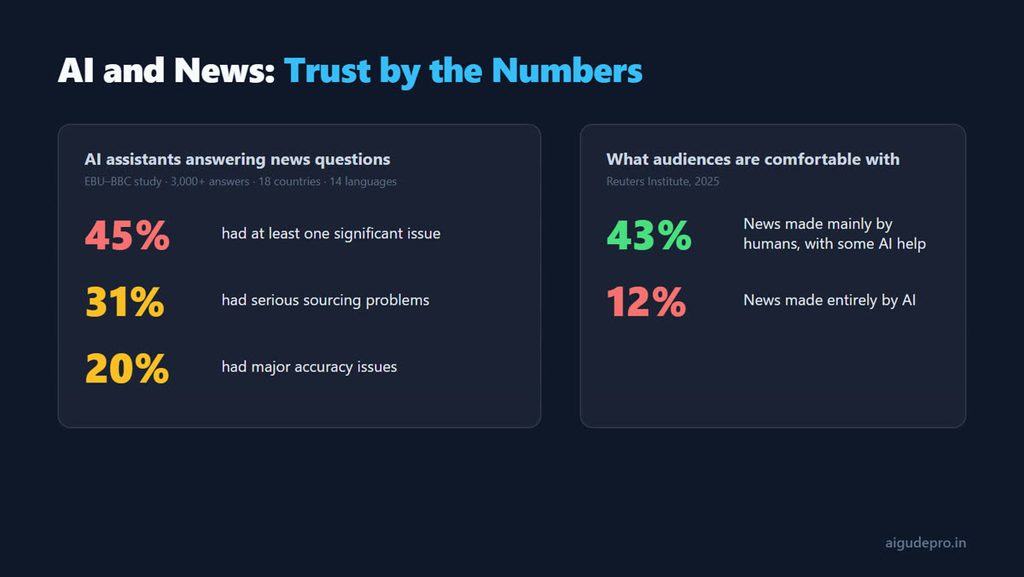
To be fair, this study looked at AI assistants answering news questions. It doesn’t measure errors in AI-assisted journalism. But it shows something important: an answer can sound completely sure of itself while its sources or facts are shaky.

Real newsrooms have learned this the hard way:
- CNET in 2023 had to correct more than half of the dozens of AI-assisted finance articles it published.
- Sports Illustrated faced heavy criticism in 2023 over articles linked to fake, AI-generated author profiles.
- In 2025, the Chicago Sun-Times ran an AI-made summer reading list that included books that don’t exist.
AI makes it cheaper and faster to produce information. Sadly, that same speed makes it easier to spread misinformation, weak sourcing and claims taken out of context.
What Readers Actually Want
Audiences are paying attention. A 2025 Reuters Institute study found that:
- 43% of people were comfortable with news made mainly by humans with some AI help
- Only 12% were comfortable with news made entirely by AI
The Reuters Institute also stressed that journalists should help build newsroom AI systems. That way editorial, ethical and professional standards are built in from day one, not added as an afterthought.
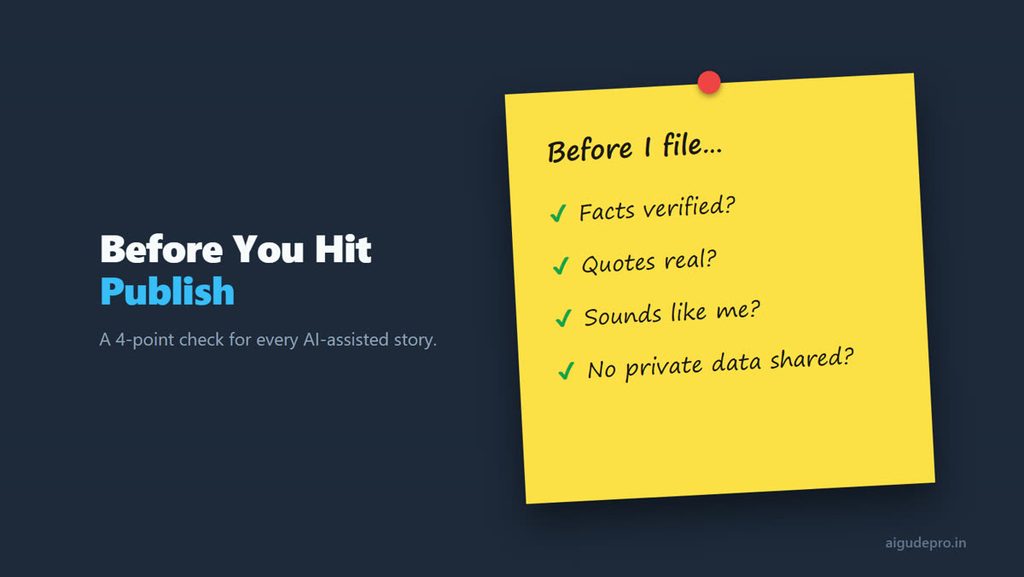
⚠️ Warning: AI doesn’t know when it’s wrong. Verify every name, number, date and quote against the original source before you publish.
AI Literacy Is Now a Leadership Job
Research published in the journal AI & Society, which spoke with journalists in the US, UK, China and India, found clear gaps in practical training and resources for using AI responsibly.
That makes AI literacy a job for newsroom leaders, not just the tech team. And training can’t stop at “here are some prompts.” Journalists need to:
- Understand what AI can and can’t do
- Check and verify every AI output
- Spot bias in AI answers
- Ask tough questions about the technology itself
The Rules Every Newsroom Needs
Using AI well isn’t just a tech project. Editors need to set clear rules about:
- Where AI is allowed. Which tasks are fine, and which are off-limits?
- What information can go in. Confidential sources and private data should never be pasted into public AI tools.
- When human review is a must. Anything published needs a human check.
- When to tell readers. If AI played a major role, say so.
- The right to say no. Journalists must be free to question, correct or reject any AI output, even when it sounds confident.
Common Mistakes to Avoid
Whether you’re a reporter, blogger or student, watch out for these:
- Trusting AI “sources.” AI can invent links and citations. Always click through and confirm.
- Treating a lead as a fact. A pattern AI finds is only a starting point for reporting.
- Publishing raw output. Generic AI text reads flat, and readers notice.
- Trusting word-for-word translations. Meaning and tone can get lost.
The Real Measure of AI: Better Journalism
The AI era needs a new way to define productivity.
Here’s a simple example. If AI saves two hours but creates two hours of corrections, nothing was saved. A publisher shouldn’t celebrate speed that ends in mistakes.
The numbers that matter come after a human has reviewed the work:
| ❌ Old Way to Measure | ✅ Better Way to Measure |
|---|---|
| How many stories went out | How much reporting time was recovered |
| How fast a draft was ready | How many errors were caught before publishing |
| How many tasks AI completed | How much extra reporting became possible |
| Clicks and page views | Whether readers got news they could trust |
Looking to apply this to your own work? Our AI productivity tips for everyday work show how to save time without cutting corners.
Frequently Asked Questions (FAQ)
1. What is an AI writing assistant?
An AI writing assistant is a tool that helps you draft, edit, summarize, translate or rewrite text. Popular examples are ChatGPT, Claude, Gemini and Grammarly. It’s fast, but it doesn’t know what happened today unless you tell it.
2. Will AI replace journalists?
It’s unlikely to replace good ones. AI handles routine tasks like transcripts, summaries and data-heavy updates. It can’t interview sources, test evidence, make ethical calls or take responsibility for what gets published.
3. What does “AI + HI” mean in journalism?
It means combining Artificial Intelligence with Human Intelligence. AI brings speed and scale. Humans bring context, empathy, judgment and accountability. The best results come from using both together.
4. What tasks do major newsrooms let AI handle?
Under the Associated Press’s updated standards, AI can help with research, document summaries, transcription, translation and headline ideas. Sourcing, verification and editorial decisions stay with journalists.
5. Can AI translate news into Indian languages accurately?
It can produce fast first drafts in languages like Hindi, Marathi, Tamil and Bengali. But it can miss cultural references, tone and local expressions. A human language editor should always review the final version.
6. How accurate are AI assistants with news?
Not accurate enough to trust blindly. In the EBU–BBC study, 45% of more than 3,000 AI answers about news had at least one significant issue. Always verify facts against original sources.
7. Should I tell readers when I use AI?
Yes, when AI played a major role in creating the content. Being open about it builds trust. Readers are much more comfortable with human-led content that uses some AI help than with content made entirely by AI.
8. Does Google penalize AI-written content?
Google says it rewards helpful, high-quality content no matter how it was made. The real risk is publishing thin or wrong content that readers stop trusting.
9. Should journalism students learn AI?
Absolutely. AI literacy is quickly becoming a core newsroom skill, and research shows many journalists still lack proper training. Explore our list of AI tools for students to get started.
Conclusion: Knowing When the Journalist Takes Over
Let’s go back to that reporter at 11:47 p.m.
She lets AI transcribe her memos and sort her notes. That buys her time. She uses that time to call a witness, check the records and catch a “fact” the AI made up. Her story goes out on deadline, accurate and human.
That’s the real promise of AI in journalism. It gives newsrooms remarkable capacity to search more, process more, translate more and reach more people. But remember:
- Capacity is not judgment.
- Speed is not accuracy.
- Information is not journalism.
Technology can expand what a newsroom is able to do. Human intelligence decides where that power goes. And in journalism, where attention goes shapes what the public gets to know.
So are AI writing assistants the future of journalism? They’re a big part of it. But the most important decision will stay a human one: knowing when the machine has done enough, and it’s time for the journalist to take over.
Ready to try it yourself? Pick one task this week, like transcription, outlining or headline ideas, and let AI help. Then review the result like an editor would. For more ideas,