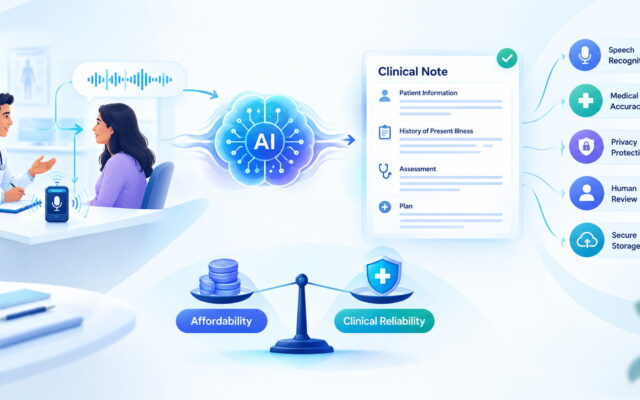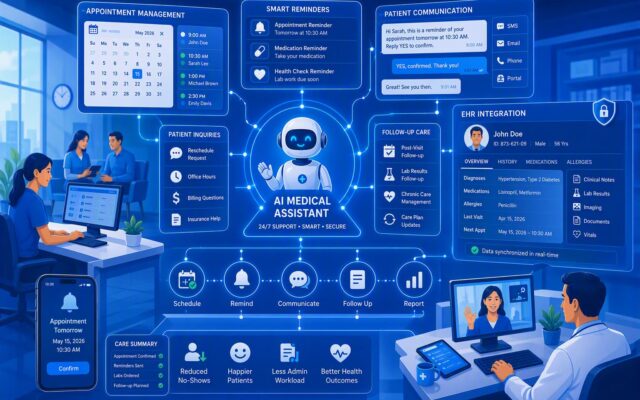
Introduction
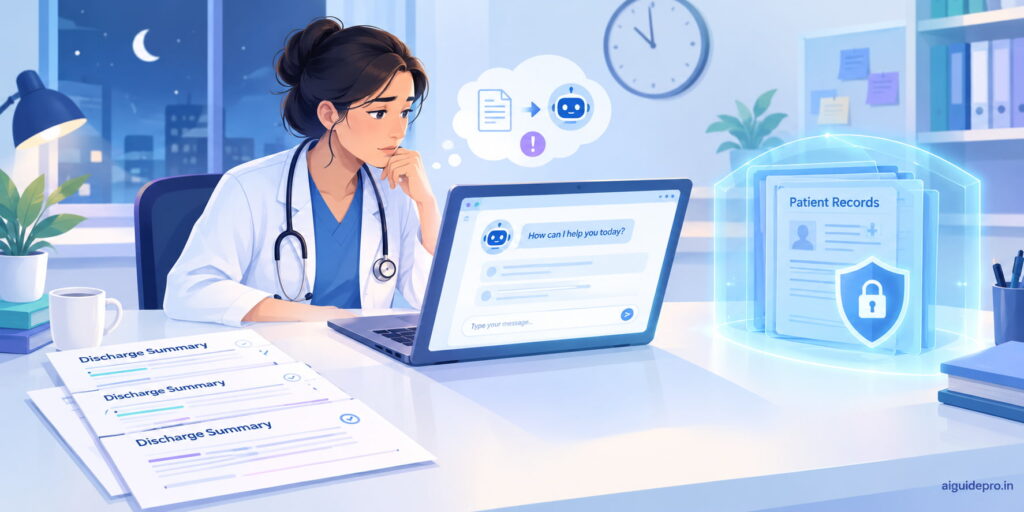
It’s 11 p.m. You have three discharge summaries left, and ChatGPT is one copy-paste away. It’s tempting. But can you put patient data into ChatGPT without breaking the law?
The short answer: usually not with a regular account. Here’s what HIPAA and India’s DPDP Act actually say, and how to use AI safely.
What Is Patient Data in ChatGPT?
“Patient data in ChatGPT” means any health information about a real person that you type, paste, or upload into a chat. If the details could point back to a specific patient, treat it as sensitive.
Think of patient data like a house key. A single key on the street means little. But a key tagged with a street address? Now anyone can walk in. Health details work the same way. A blood sugar reading alone is harmless. Pair it with a name, a birth date, or a hospital ID, and it becomes someone’s private story.
In the US, HIPAA calls this protected health information (PHI). In India, the DPDP Act simply calls it personal data, and health data falls squarely inside it.
Here’s what usually counts:
- Names, phone numbers, email and home addresses
- Dates tied to a person, such as birth, admission, or discharge dates
- Diagnoses, symptoms, medications, and treatment plans
- Lab reports, scans, X-rays, and photos of wounds or skin conditions
- Patient IDs, insurance numbers, Aadhaar or ABHA numbers, and billing records
- Voice recordings of consultations
One point trips people up. Data doesn’t need a name to identify someone. A rare condition plus a small town plus an age can be enough.
Tip: If you’d feel uneasy reading the text aloud in a crowded waiting room, it probably contains patient data.
Can You Put Patient Data into ChatGPT?
Not into a regular ChatGPT account. Free, Plus, Pro, and Business plans are not set up for identifiable patient data. You can use identifiable data only in an approved healthcare setup, under the right contract, with your organisation’s sign-off.
So the honest answer is “it depends.” But it depends on four specific things, not on luck.
- The type of data. Fully de-identified or fictional data is low risk. Anything that can identify a real patient is high risk.
- The account you use. A personal account is like discussing a case in a public café. An approved healthcare workspace is more like a locked consultation room.
- The features you switch on. Even inside an approved plan, some features sit outside the legal agreement. Connected apps, memory, or certain automations may not be covered.
- The privacy rules that apply. A US clinic must follow HIPAA. An Indian hospital falls under the DPDP Act. Many organisations also have their own stricter policies.
Here’s a quick way to picture it:
| Situation | Is it okay? |
|---|---|
| Asking ChatGPT to explain a drug interaction in general terms | Yes |
| Writing a patient leaflet on diabetes diet | Yes |
| Pasting a de-identified case built from fictional details | Usually yes |
| Pasting a real lab report into a personal ChatGPT account | No |
| Using an approved enterprise healthcare plan your hospital set up | Yes, within its policy |
The rest of this guide explains why each line lands where it does.
Warning: “Everyone in my department does it” is not a compliance strategy. Regulators judge the action, not how common it is.
What Is HIPAA and Who Must Follow It?
HIPAA is the US law that protects health information. Its full name is the Health Insurance Portability and Accountability Act of 1996. Its privacy and security rules decide who can see, share, and store patient data, and how it must be guarded.
HIPAA doesn’t apply to everyone, though. It covers two groups.
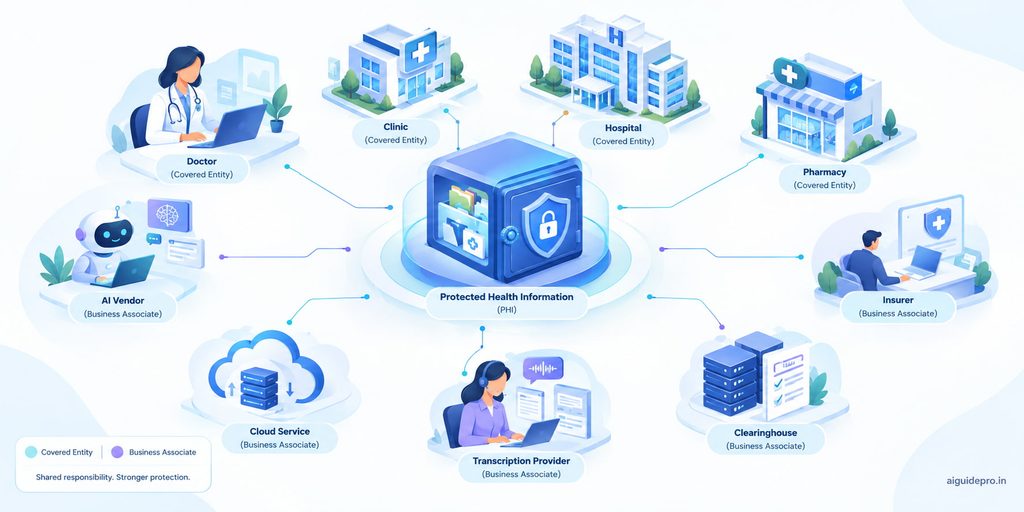
1. Covered entities. These are the main players in US healthcare:
- Doctors, clinics, hospitals, dentists, pharmacies, and therapists who bill insurance electronically
- Health insurance plans
- Healthcare clearinghouses that process claims
2. Business associates. These are outside companies that handle PHI for a covered entity. A billing firm, a cloud storage provider, a transcription service, or an AI vendor all fit here.
A simple analogy helps. A covered entity owns the vault. A business associate is the security firm hired to guard it. Both must follow the rules, and both can be fined.
HIPAA rests on three main rules:
- Privacy Rule: when PHI can be used or shared
- Security Rule: how electronic PHI must be protected
- Breach Notification Rule: who must be told when PHI leaks
The penalties are real. Civil fines can reach millions of dollars per year for repeated violations, and serious cases can lead to criminal charges.
One more thing. HIPAA protects identifiable data. Properly de-identified data falls outside it. HHS allows two methods: removing 18 specific identifiers (the Safe Harbor method), or having an expert certify that the re-identification risk is very small.
Pro Tip: If you work outside the US, HIPAA may still matter. Indian firms that handle data for US hospitals, such as medical coding and transcription companies, often sign HIPAA contracts.
Is ChatGPT HIPAA-Compliant?
Regular ChatGPT is not HIPAA-compliant by default. Some OpenAI products can support HIPAA-compliant use, but only with a signed contract and the right settings.
That difference matters. No software is “HIPAA-compliant” on its own, the way a car isn’t “safe” on its own. Safety depends on the car, the driver, and the road. ChatGPT HIPAA compliance depends on the product, the contract, and how your team actually uses it.
In January 2026, OpenAI launched ChatGPT for Healthcare, a workspace built for hospitals and health systems. It offers audit logs, data residency options, customer-managed encryption keys, and a Business Associate Agreement. OpenAI says content shared in it is not used to train its models.
What Is a Business Associate Agreement (BAA)?
A BAA is a legal contract between a healthcare provider and a vendor that handles its PHI. The vendor promises to protect the data, limit how it’s used, and report any breach. Without a signed BAA, sharing PHI with a vendor like OpenAI is generally a HIPAA violation, however careful you are.
Which ChatGPT Plans Support HIPAA-Compliant Use?
As of October 2026, OpenAI’s help centre lists these as HIPAA-eligible with a BAA:
- ChatGPT for Healthcare
- ChatGPT for Enterprise with Regulated Workspace
- ChatGPT for Clinicians (for verified US clinicians)
- ChatGPT FedRAMP
OpenAI’s API can also be covered under a BAA for eligible customers. Even on these plans, some features sit outside the BAA, so admins must check which ones are switched on.
Why a Regular ChatGPT Account May Not Be Suitable
Free, Plus, Pro, and Business plans come with no BAA. On consumer plans, your chats may help train future models unless you turn that setting off. You also control far less: no audit trail, no admin oversight, and no contract promising breach notification. For PHI, that’s simply not enough.
Warning: Turning off model training in a personal account does not make it HIPAA-compliant. It only fixes one of many gaps.
What Is India’s DPDP Act?
The Digital Personal Data Protection Act, 2023 is India’s main privacy law for digital personal data. Unlike HIPAA, it isn’t a healthcare law. It covers every organisation that handles personal data, from hospitals and labs to apps and online pharmacies.
The Act uses a few key terms worth knowing:
| Term | What it means | Healthcare example |
|---|---|---|
| Data Principal | The person the data is about | The patient |
| Data Fiduciary | The organisation that decides why and how data is used | The hospital or clinic |
| Data Processor | A company that processes data for the fiduciary | A cloud, billing, or AI vendor |
| Data Protection Board | The regulator that enforces the law | Hears complaints and imposes fines |
The government notified the DPDP Rules, 2025 in November 2025. They roll out in phases over 18 months. The Data Protection Board came first. Consent manager rules follow in November 2026. Most core duties, such as notice, consent, security safeguards, and breach reporting, become enforceable in May 2027.
Don’t read that timeline as a free pass. Until then, India’s IT Act and its 2011 rules already treat medical records as sensitive personal data. And building good habits now is far easier than rebuilding them under deadline pressure.
The penalties are steep. Failing to take reasonable security safeguards can attract a fine of up to ₹250 crore. Failing to report a breach can cost up to ₹200 crore.
Tip: The DPDP Act has no separate “sensitive data” category. But health data is exactly the kind of data that causes the most harm if leaked, so regulators and courts are likely to expect stronger care.
Does India’s DPDP Act Allow Patient Data in ChatGPT?
The DPDP Act doesn’t ban AI tools, but it doesn’t give you a free pass either. It asks a simple question: is this use of the patient’s data lawful, limited, and secure? Pasting a report into a personal chatbot usually fails all three.
Regular ChatGPT is not automatically DPDP-ready
Just as a regular account isn’t HIPAA-compliant by default, it isn’t automatically fit for Indian patient data either. The law puts the duty on the hospital or clinic as the data fiduciary. OpenAI isn’t the one answering to the patient. You are.
Why regular ChatGPT is not enough
Picture Dr. Meera, a GP in Kochi. She pastes a patient’s thyroid report into her personal ChatGPT to draft a quick explanation. Here’s where it goes wrong:
- Purpose: the patient shared data for treatment, not for an outside chatbot.
- No processor contract: the Act expects fiduciaries to use processors only under a valid contract. A personal account has no such contract with the clinic.
- Security: the clinic can’t control retention, access, or deletion in Meera’s personal account.
- Accountability: if a breach happens, the clinic must report it, yet it may not even know the data left.
When ChatGPT can support DPDP-compliant use
An AI tool can fit within the DPDP Act when your organisation:
- Picks an enterprise or healthcare plan with a proper data processing agreement
- Has a lawful basis, such as clear consent or a permitted use like treatment
- Tells patients how their data is used, in plain language
- Applies security controls, access limits, and retention rules
- Has a plan to detect and report breaches
The Act also allows data to be transferred outside India, unless the government restricts a specific country. So overseas hosting isn’t automatically a problem. Weak contracts and controls are.
Simple rule to remember
No approval, no contract, no patient data. If your hospital hasn’t approved the tool for identifiable data, keep real patient details out.
HIPAA vs. India’s DPDP Act: What Is the Difference?
The simple difference
HIPAA is a healthcare privacy law for certain US organisations. The DPDP Act is a general data privacy law that covers almost every organisation handling digital personal data in India. One is a specialist; the other is a general physician.
Quick comparison
| Point | HIPAA (US) | DPDP Act (India) |
|---|---|---|
| Scope | Health information only | All digital personal data, including health |
| Who must follow it | Covered entities and business associates | Any data fiduciary and its processors |
| Main legal basis | Treatment, payment, and operations allowed without separate consent | Consent, or a listed “legitimate use” |
| Vendor contract | Business Associate Agreement | Contract with the data processor |
| Breach reporting | Individuals within 60 days; HHS; media if 500+ affected | Data Protection Board and affected people |
| Top penalties | Millions of US dollars per year, plus possible criminal charges | Up to ₹250 crore per instance |
| In force | Since the early 2000s | Phased; core duties from May 2027 |
Who must follow each law?
Under HIPAA, a wellness app that never bills insurance may fall outside the law. Under the DPDP Act, that same app in India would almost certainly be covered.
Consent: a major practical difference
US providers can share PHI for treatment and billing without fresh consent each time. In India, consent sits at the centre. It must be free, specific, informed, and as easy to withdraw as to give. Medical emergencies are an exception.
What rights do people have?
Both laws let patients access their data and ask for corrections. The DPDP Act adds erasure rights, a grievance process, and the right to nominate someone to act after death or incapacity.
Easy example
A Bengaluru hospital treating Indian patients follows the DPDP Act. An Indian transcription firm working for a Texas clinic must meet HIPAA through its BAA. If it also handles Indian patients, both laws apply.
What Patient Data Should You Never Enter into Regular ChatGPT?
When it comes to ChatGPT and patient data, some details are simply off-limits in a regular account. If it can identify a real patient, leave it out. Here are the four big categories.
Names, Phone Numbers, and Addresses
These are the most obvious identifiers, yet they slip in all the time. A pasted email thread or referral letter often carries a name, phone number, or home address at the bottom. Scan for them before you paste anything.
Medical Records and Lab Reports
Case notes, discharge papers, and lab results are packed with clues: dates, ward numbers, doctor names. Even tools built for AI SOAP notes need approved setups. Deleting a name alone rarely de-identifies a clinical note.
Photos, Scans, and Medical Images
X-rays, MRIs, and wound photos often carry hidden metadata or burned-in text, such as the patient’s name and scan date. A tattoo, face, or birthmark can also identify someone. Never upload these to a personal account.
Patient IDs, Prescriptions, and Billing Records
Hospital IDs, ABHA or Aadhaar numbers, insurance numbers, and invoices tie data straight to one person. Prescriptions add doctor names and dates. Treat every one of these numbers like a password.
Pro Tip: Keep a sticky note by your screen with one question: “Could someone figure out who this is?” If the answer is maybe, don’t paste it.
How to Use ChatGPT Safely in Healthcare
You don’t have to give up AI to stay compliant. You just need a few habits, like washing your hands before touching a patient. Here are five that cover most situations.
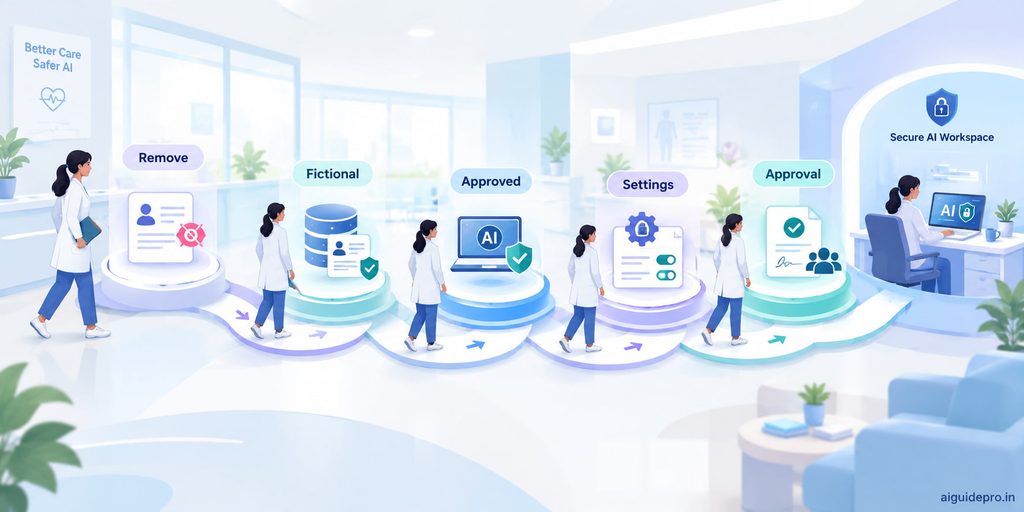
1. Remove Direct Patient Identifiers
Before you paste, strip out names, dates, phone numbers, IDs, and locations. Replace them with neutral labels such as “Patient A” or “a woman in her 50s.” Round ages and drop exact dates. Remember, removing direct identifiers lowers risk but doesn’t remove it. Rare conditions can still point to one person.
2. Use Synthetic or Fictional Patient Data
The safest patient is one who doesn’t exist. Build a made-up case that matches the clinical pattern you need, then ask ChatGPT for help. For example: “A 45-year-old man with type 2 diabetes and an HbA1c of 9% asks about diet. Draft a simple explanation.” You get the same useful output with zero privacy risk.
3. Choose an Approved AI Account or Tool
If you must work with real patient data, use a tool your organisation has approved and covered by a proper contract, such as a BAA in the US or a processor agreement in India. This applies to every tool, not just ChatGPT. Before trying medical transcription tools, check each one’s privacy terms and data handling. A low price never means automatic compliance.
4. Review Privacy, Retention, and Access Settings
Check whether chats are used for training, how long they’re stored, and who can see them. Turn off memory and connected apps unless your admin has approved them. Delete chats you no longer need, and never share chat links containing clinical details.
5. Get Organizational Approval Before Use
Talk to your privacy officer, IT team, or hospital administration first. Ask which tools are approved and for what tasks. A two-minute email now can save you from a disciplinary hearing later.
Tip: Ask your organisation for a written “AI use policy.” If none exists, you’ve just spotted a gap worth raising.
What Healthcare Tasks Can You Use ChatGPT For?
Plenty, as long as no real patient’s details go in. The rules aren’t there to scare you off AI. They guide you toward the many tasks where ChatGPT shines safely. For a wider look at what’s possible, see this guide to AI for doctors.
Drafting General Patient Education Materials
Ask ChatGPT to write a leaflet on managing high blood pressure, in simple English or Malayalam. Then review it for accuracy before sharing. Try this prompt: “Explain asthma inhaler technique for a 10-year-old, in five short steps.”
Creating Administrative Templates
Appointment reminders, consent form layouts, staff rotas, and referral letter templates are all fair game. Build the structure with ChatGPT, then fill in patient details later inside your secure hospital system.
Summarizing Public Medical Research
Paste the abstract of a published study or ask about public guidelines. ChatGPT can explain methods and findings in plain words. Always check the original paper, since AI can misread numbers or invent citations.
Improving Clinical Documentation Workflows
AI can help draft discharge summaries and AI SOAP notes faster. Use templates and fictional examples in regular ChatGPT. Process real patient notes only through an approved, compliant setup.
What Are the Risks of Uploading Patient Data to AI?
Uploading patient data to an unapproved AI tool is like mailing medical records in a clear envelope. Most of the time nothing happens. But you’ve lost control the moment it leaves your hands.
Privacy Breaches and Unauthorized Access
Personal accounts can be hacked, shared, or left logged in on a family laptop. A leaked chat history could expose diagnoses that patients never agreed to share. For conditions like HIV, mental illness, or pregnancy, the harm can be lasting.
Data Retention and Third-Party Processing
Once you hit send, the data sits on someone else’s servers. Depending on your plan, it may be stored for weeks or used to improve models. You can’t promise a patient their data was deleted if you don’t control the system.
Inaccurate Answers and Clinical Errors
ChatGPT can sound confident and still be wrong. It may misread a lab value, miss a drug interaction, or invent a reference. Treat every output as a draft from a bright intern: useful, but always checked by you.
Legal and Professional Consequences
Breaking HIPAA or the DPDP Act can bring large fines for your organisation. You may also face disciplinary action, loss of your job, or complaints to your medical or nursing council. Patient trust, once broken, is very hard to rebuild.
Warning: Your licence is personal. “The AI did it” won’t protect you from professional responsibility.
What Should You Do If You Accidentally Share Patient Data?
Mistakes happen, especially on long shifts. What matters most is how fast and honestly you respond. Hiding it almost always makes things worse.
Stop Sharing More Information
Don’t add more details or upload more files. Take screenshots of what was shared, note the time, then delete the chat. Deleting doesn’t undo the exposure, so it isn’t the end of the process.
Notify Your Privacy or Security Team
Tell your privacy officer, data protection officer, or IT security team right away. Share what data went in, which tool and account you used, and when. They need the full picture to judge the risk.
Follow Incident Response and Reporting Rules
Your organisation decides whether this counts as a reportable breach. In the US, HIPAA requires notifying affected patients within 60 days of discovery when a breach is confirmed. In India, the DPDP Rules require informing the Data Protection Board and affected patients. Let the experts handle those steps.
Tip: Save your privacy team’s contact details in your phone today. In a panic, you won’t want to search the intranet.
Frequently Asked Questions
Can doctors use ChatGPT with patient information?
Yes, but only through an approved setup. In the US, that means a HIPAA-eligible plan with a signed BAA. In India, it means an organisation-approved tool with a proper processor contract. A personal account isn’t the right place for identifiable patient information.
Is ChatGPT HIPAA-compliant by default?
No. Is ChatGPT HIPAA compliant out of the box? Free, Plus, Pro, and Business plans offer no BAA. Only specific products, such as ChatGPT for Healthcare, can support HIPAA-compliant use after a BAA is signed and settings are configured.
Can Indian doctors upload patient reports to ChatGPT?
Not to a personal account. Under the DPDP Act, the hospital or clinic is responsible for how patient data is used and secured. Upload reports only to tools your organisation has approved, with clear patient notice and a lawful basis.
Does removing a patient’s name make data safe?
Not always. Dates, locations, ID numbers, rare diagnoses, and image metadata can still identify someone. HIPAA’s Safe Harbor method lists 18 identifiers to remove, not just one. When in doubt, use fictional data instead.
Can ChatGPT use patient data for model training?
On consumer plans, chats may be used to improve models unless you switch that setting off. OpenAI says business and healthcare plans don’t use your content for training by default. Either way, check the current settings and terms.
Is ChatGPT Enterprise automatically HIPAA-compliant?
No. Enterprise plans can become HIPAA-eligible, but only after OpenAI signs a BAA with your organisation. Some features may still fall outside the BAA, and your team must use the tool correctly.
Does the DPDP Act apply to AI tools hosted outside India?
Yes, in practice. The Act covers processing outside India when it relates to offering goods or services to people in India. Your hospital remains responsible for patient data, even when the AI vendor’s servers sit abroad.
What is the safest way to use ChatGPT for medical work?
Use fictional or fully de-identified examples for drafting, learning, and templates. Keep real patient data inside approved, compliant systems. Review every output yourself before it reaches a patient or a chart.
Final Thoughts
So, can you put patient data into ChatGPT? Not into a regular account, and only into an approved healthcare setup when the law and your organisation allow it. Use AI for the heavy lifting on templates, education, and research, and keep real patient details behind locked doors. Your patients trust you with their stories. Keep that trust, and let AI save you time without costing you anything that matters.
Disclaimer: This article is for general information only and is not legal advice. Check with your organisation’s privacy or legal team before using AI with patient data.
Sources
- OpenAI Help Center: HIPAA eligible products and functionality
- Healthcare Finance News: OpenAI launches ChatGPT for Healthcare
- Fierce Healthcare: OpenAI rolls out ChatGPT for Healthcare
- PIB: DPDP Rules, 2025 notified
- DPDP Act 2023 and Rules 2025: phased implementation timeline
- HHS: Methods for de-identification of PHI under HIPAA