Introduction
Charting after a long shift feels like running a second marathon. You’ve cared for patients all day, and now the notes are waiting. That’s where AI SOAP notes come in. In this guide, I’ll walk you through how these tools work, why nurses love them, and the 10 best options to try.
What Are AI SOAP Note Tools?
First: What is a SOAP note?
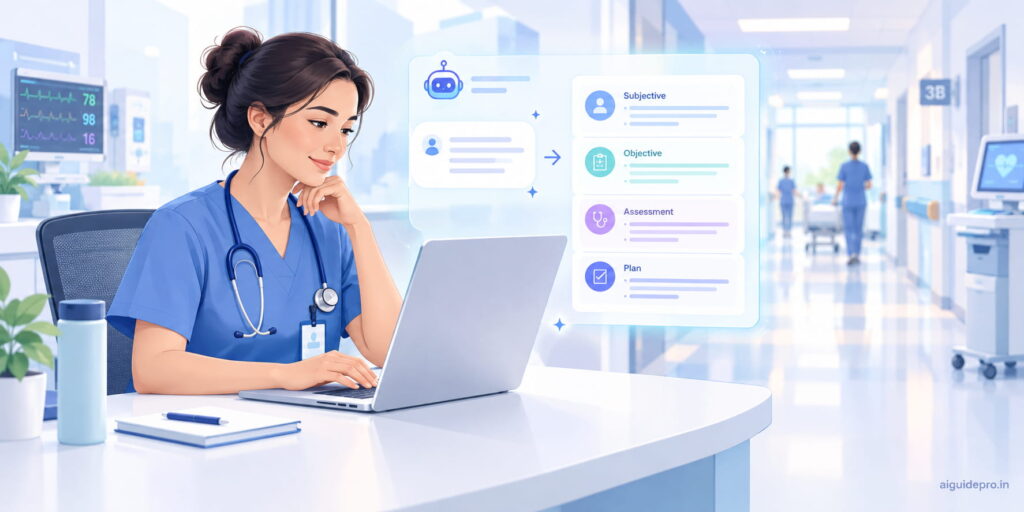
A SOAP note is a simple way to write down a patient visit. It has four parts:
- S – Subjective: What the patient tells you, like “My chest feels tight.”
- O – Objective: What you can measure, like vital signs and lab results.
- A – Assessment: What you think is going on.
- P – Plan: What happens next.
Think of it as a four-drawer filing cabinet. Every fact has its own drawer.
What does “AI SOAP Note Tool” mean?
An AI SOAP note tool listens to a conversation or reads your rough notes. Then it sorts everything into those four drawers for you. Some tools record the visit live. Others turn your typed shorthand into a clean draft. These tools are one part of a bigger family of healthcare AI tools built for clinical documentation.
Simple example
You type: “Pt c/o headache x2 days, BP 150/95, likely HTN, recheck in 1 wk.” An AI SOAP note generator turns that into four neat, labeled sections in seconds.
Why Nurses Use AI for SOAP Notes
What is a SOAP note (for nurses)?
For nurses, a SOAP note is more than paperwork. It’s the story of a patient’s shift. It tells the next nurse what changed, what you did, and what to watch for. Doctors, therapists, and pharmacists read it too. So it has to be clear, complete, and fast to scan.
Why nurses use AI
Here’s the honest truth: documentation eats a big chunk of every shift. Many nurses finish their charting after clock-out, tired and rushing. That’s when details slip.
AI nursing documentation tools act like a quiet helper standing beside you. They capture what you say, sort it, and hand you a draft. You still check it and sign it. But you skip the blank-page struggle. That’s why more hospitals now offer nursing AI tools as part of daily workflows.
Simple example
Picture a med-surg nurse with five patients. After each assessment, she speaks a quick summary into her phone. By the end of rounds, the AI has five draft notes ready. She spends ten minutes reviewing instead of an hour typing. That extra time goes back to her patients, or her own dinner break.
Benefits of Using AI for Nursing SOAP Notes
So what do you actually get from AI nursing notes? Let’s break it down.
Saves Time
This is the big one. Typing a full note from scratch can take 10 to 15 minutes. Reviewing an AI draft often takes two or three. Over a 12-hour shift, those minutes stack up like coins in a jar.
Helps Nurses Focus on Patients
When a tool handles the typing, your eyes stay on the patient, not the screen. You can listen better and notice small changes, like a new wince or a pale lip.
Makes Notes More Organized
AI follows the same SOAP structure every time. No more mixing assessment findings into the plan. Every note looks clean and predictable, which makes it easier to read.
Reduces Missed Details
Tired brains forget things. An AI that listens to the whole conversation catches the small stuff, like a patient mentioning dizziness in passing. You still verify it, but it’s on the page to check.
Supports Faster Handoffs
Shift change is like passing a baton in a relay race. A clear, well-organized note makes that pass smooth. The incoming nurse finds what she needs in seconds.
Simple Example
A home health nurse sees six patients a day. Before AI, she charted every night at her kitchen table. Now she reviews drafts in her car between visits. Her evenings are hers again, and her notes are tidier than ever.
How AI SOAP Note Generators Work
How the AI works
Most AI SOAP note generators follow three simple steps:
- Capture. The tool records the conversation (ambient listening), takes your dictation, or reads your typed shorthand.
- Understand. Speech recognition turns audio into text. Then a large language model reads it and pulls out the key facts: symptoms, vitals, medications, and concerns.
- Organize. The AI drops each fact into the right SOAP section and writes it in clinical language.
Think of it like a skilled sous-chef. You bring the raw ingredients. The AI chops, sorts, and plates them. But you’re still the head chef who tastes the dish before it leaves the kitchen.
A simple example
A patient says, “I’ve been coughing for a week and my chest hurts when I breathe.” You check and note a temp of 101.2°F and crackles in the right lower lobe. The AI writes the cough and chest pain under Subjective, the fever and lung sounds under Objective, and suggests possible pneumonia under Assessment.
The clinician must review it
This part matters most. AI can mishear words, mix up drugs that sound alike, or add a detail that never happened. Always read every line before you sign. Your license, not the software, stands behind that note. Also make sure the tool is HIPAA-compliant (or meets your country’s privacy laws) and approved by your employer.
Why people use them
Nurses use these tools to cut charting time, reduce burnout, and write more consistent notes. But not every tool fits every setting. A hospital nurse needs EHR integration, while a student may just need a simple template. If you’re unsure where to start, this guide on how to choose an AI tool can help you match a tool to your workflow.
Top 10 AI Tools for Writing SOAP Notes for Nurses
Now for the fun part. I’ve sorted these tools into two rough groups. The first few are enterprise tools that hospitals roll out across whole units. The rest are easier to try on your own. As you read, keep your own setting in mind. A tool that shines in an ICU may be overkill for a school nurse. If you want to line up features side by side, try this AI tool comparison builder.
1. Microsoft Dragon Copilot for Nurses
Microsoft Dragon Copilot is one of the few tools built from the ground up for nursing workflows. Instead of only writing a narrative note, it listens to your bedside observations and turns them into structured flowsheet entries. You review them, approve them, and send them into the EHR.
Key features:
- Ambient capture of real-time observations at the bedside
- Flowsheet documentation ready for quick nurse review
- Drafts nurse notes and shift summaries from conversations
- Surfaces relevant patient data so you search less
- Works with Epic Rover on mobile and with desktop EHRs
Best for: Hospital nurses in large US health systems that already use Epic.
Keep in mind: It’s sold to organizations, not individuals, and is currently available in the United States. You can’t just sign up on your phone tonight.
2. Abridge for Nurses
Abridge made its name with physicians, and its nursing platform brings the same idea to the bedside. It turns nurse-patient conversations into draft flowsheet entries right inside Epic.
What I like most is “linked evidence.” Each piece of the draft traces back to the exact moment in the conversation. So if something looks off, you can check the source in seconds. It’s like having a receipt for every line.
Key features:
- Real-time draft flowsheet documentation from conversations
- Linked evidence back to the original audio
- Clinical context and care-team activity to support handoffs
- Works across multiple devices and in-room setups
- Embedded directly in Epic
Best for: Inpatient nursing teams in Epic-based hospitals.
Keep in mind: Abridge reports that Reid Health saw 27 minutes saved per nurse per shift. Like Dragon Copilot, it’s an enterprise purchase.
3. S10.AI
S10.AI is more of an AI workforce than a single scribe. Its scribe, called CRUSH, records visits in person, by phone, or over telehealth. It then builds structured notes with suggested codes, usually in under a minute.
Key features:
- Ambient scribe with notes delivered in under 60 seconds
- Support for 60+ languages
- Works with 100+ EHRs
- Custom AI agents, including an “AI Nurse” role for routine tasks
- Built-in note audits for quality and compliance
Best for: Clinics and practices that want one platform for notes, phones, and admin work.
Keep in mind: Pricing isn’t listed publicly, so you’ll need to book a demo.
4. Heidi Health
Heidi Health is one of the friendliest places to start. It has a free tier, works in your browser or as a desktop app, and handles 77 languages. That’s a big deal if your patients don’t all speak English.
Key features:
- Real-time transcription and note generation
- 25+ templates, including shift handovers and care plans
- Dictation anywhere on your screen with the desktop app
- Strong security credentials, including HIPAA, GDPR, and SOC 2 Type II
- Used by physicians, nurses, and allied health staff
Best for: Nurses who want to test AI SOAP notes for free before asking their employer about it.
Keep in mind: Always confirm your employer allows outside tools before using real patient data.
5. Nabla
Nabla is an ambient AI assistant used by more than 85,000 clinicians. It listens to the visit and turns it into a clean, structured note. It also offers clinical-grade dictation inside Epic and other major EHRs.
Key features:
- Ambient documentation with specialty customization
- Integrations with Epic, athenahealth, Oracle Health, NextGen, and more
- Coding suggestions for E/M and ICD-10
- HIPAA, SOC 2 Type 2, ISO 27001, and GDPR compliance
- English and French support
Best for: Nurse practitioners and clinic teams in health systems using a major EHR.
Keep in mind: Nabla’s site focuses on clinicians broadly. It doesn’t have a separate nursing product, so check whether it fits your note style.
6. DeepScribe
DeepScribe is the specialist on this list. It focuses on specialty care, especially oncology. If you’re an oncology nurse or NP, this one deserves a close look.
Key features:
- Ambient scribe tuned for specialty-specific language
- SmartPrep surfaces patient data before the visit
- A customization studio that learns your note preferences
- Works with OncoEMR, iKnowMed, and Epic
- SOC 2 and HIPAA compliant
Best for: Oncology, cardiology, and other specialty practices.
Keep in mind: DeepScribe says providers cut note time from 7–10 minutes down to 1–2. But it’s built for specialty clinics, not general floor nursing.
7. Freed
Freed is popular with independent clinics and nurse practitioners. It’s simple, affordable, and quick to set up. You press record, talk with your patient, and get a SOAP note when you’re done.
Key features:
- AI scribe that turns conversations into structured notes
- Templates for 30+ specialties
- One-click push into browser-based EHRs
- Doesn’t store patient recordings
- Free trial, then plans starting at $39/month
Best for: NPs and nurses in small or independent practices.
Keep in mind: It shines in outpatient visits. It’s less suited to inpatient flowsheet work.
8. SOAP Note Buddy
SOAP Note Buddy takes a clever approach. It works as a browser extension, so it can fill in fields in almost any web-based EHR. No special integration needed. It also has mobile apps for iPhone and Android.
Key features:
- Browser extensions for Chrome, Safari, Edge, and Brave
- Auto-fills EHR fields in 1–2 minutes
- Strips personal health information before processing
- Unlimited notes on every plan
- 7-day free trial, then plans from $29/month
Best for: Home health nurses and therapists who chart in web-based systems.
Keep in mind: It’s designed for individual clinicians, so check with IT before installing extensions on work computers.
9. Suki
Suki calls itself one of the most deeply embedded ambient AI tools on the market. It works inside Epic, Oracle Health, athenahealth, and MEDITECH. You can also edit notes with your voice, which is handy when your hands are full.
Key features:
- Ambient note generation, patient instructions, and orders
- Voice-enabled editing and dictation
- Desktop, iOS, and Android support
- 100+ specialties covered
- Used by 400+ health systems and partners
Best for: NPs and advanced practice nurses in larger organizations.
Keep in mind: Suki doesn’t advertise a nursing-specific product. It’s best for provider-style SOAP notes.
10. SOAPNoteAI
SOAPNoteAI is the most flexible SOAP note generator here for input. You can record a session, dictate, type shorthand, upload an audio file, or record a telehealth visit. Then an assistant named “Penny” helps you tweak the tone and detail.
Key features:
- Five ways to create a note, including plain text shorthand
- Patient summaries, referral letters, and treatment plans
- Free trial with 20 notes
- Plans from $200/year, or pay-as-you-go packs
- 50% student discount
Best for: Nursing students and NPs who want low-cost practice with SOAP structure.
Keep in mind: For students, use made-up or fully de-identified cases only. Never paste real patient details into any tool your school hasn’t approved.
Quick comparison
| Tool | Best for | Free option | Starting price* |
|---|---|---|---|
| Microsoft Dragon Copilot | Hospital nurses (Epic) | No | Enterprise quote |
| Abridge | Inpatient nursing (Epic) | No | Enterprise quote |
| S10.AI | All-in-one clinic AI | No | Demo |
| Heidi Health | Trying AI for free | Yes, free tier | Free |
| Nabla | Clinics on major EHRs | No | Contact sales |
| DeepScribe | Oncology and specialty care | No | Contact sales |
| Freed | Independent NPs | Free trial | $39/month |
| SOAP Note Buddy | Web-based EHRs | 7-day trial | $29/month |
| Suki | Large health systems | No | Contact sales |
| SOAPNoteAI | Students and small practices | 20 free notes | $200/year |
*Prices as listed on each tool’s website in October 2026. They can change, so check before you buy.
Still haven’t found the right fit? Use this AI tool finder to discover more options beyond these 10.
How to Pick the Right Tool
With ten great options, choosing can feel like standing in a cereal aisle. Here’s a quick way to narrow it down:
- Check your setting first. Hospital floor? Look at Dragon Copilot or Abridge. Clinic or private practice? Try Freed, Nabla, or Suki. Home health? SOAP Note Buddy is worth a test.
- Ask what your employer already approves. Many hospitals have signed contracts with one vendor. Using an unapproved tool with real patient data can put your job and your patients’ privacy at risk.
- Test with fake data. Run a made-up patient story through a free trial. See how the draft reads before you trust it.
- Look for a BAA. In the US, any tool that touches patient data should sign a Business Associate Agreement under HIPAA.
- Time yourself. Track how long notes take before and after. Numbers beat gut feelings.
Final Thoughts
AI won’t replace the clinical judgment you’ve built over years at the bedside. But it can take the heaviest, most repetitive part of charting off your shoulders. The best AI SOAP note generator is the one that fits your workflow, follows your privacy rules, and gives you clean drafts you can trust after a careful review.
Start small. Try one tool with a test case this week. You might be surprised how much of your shift you get back.
Frequently Asked Questions
Are AI SOAP notes safe to use?
They can be, if the tool is HIPAA-compliant (or meets your local privacy laws), approved by your employer, and you review every note before signing. Treat the AI draft like a note from a new graduate: helpful, but always double-check it.
Can nursing students use an AI SOAP note generator?
Yes, for practice. Tools like SOAPNoteAI and Heidi Health make it easy to learn the SOAP format. Just use made-up cases, and follow your school’s rules on AI.
Do AI nursing notes replace the nurse’s judgment?
No. AI organizes what you saw and heard. You decide what it means and what to do next. The assessment and plan still need your clinical thinking.
What’s the best free SOAP note generator?
Heidi Health offers a free tier. Freed, SOAP Note Buddy, and SOAPNoteAI offer free trials, so you can test them before paying.
Do these tools work with Epic?
Many do. Microsoft Dragon Copilot, Abridge, Nabla, Suki, and DeepScribe all list Epic integration. Browser-based tools like SOAP Note Buddy work with most web-based EHRs without a formal integration.